Sunday, June 23, 2013

Kenya and the 2013 Great Migration


There is great excitement as this year's vacation gets underway.

And as we plunge into our special experience, I can't help but think about what-has-been (as Beryl Markham or Karen Blixen/Isak Dinesen might have written). The difference, though, is that this experience is not about leaving somewhere. It's about going back.

Even so, Markham herself shared that sort of reverse mental picture as she wrote about a big change she was experiencing in her life.

Here's what she wrote at the opening of Chapter IX of her memoir (West with the Night):
Somebody with a flair for small cynicism one said: "We live and do not learn." But I have learned some things.
I have learned that if you must leave a place that you have lived in and loved and where all your yesterdays are buried deep - leave it any way except a slow way, leave it the fastest way you can. Never turn back and never believe that an hour you remember is a better hour because it is dead. Passed years seem safe ones, vanquished ones, while the future lives in a cloud, formidable from a distance. The cloud clears as you enter it. I have learned this, but like everyone, I learned it late.
I'm not sure I'm in agreement with Markham on this.

Yes, I very much support the contention of many, including our special Peter Drucker, whose thoughts about re-inventing one's self connects here. It is best to move forward, "opening a new page" as we move into an unknown (or perhaps - in this case - known) future. In my way of thinking about it, though, I tend to be more focused on what's coming, and what that future will bring and - I must admit - that I'm not too concerned with that "dead hour." It's gone, it's respected, I've learned from it, but I'm much more interested in what I will learn.

All this comes to mind and resonates with me as I think about my visit to Kenya. My pleasure in this journey is sweetly strengthened by the fact that this time we bring with us four "new" visitors, introducing them to our (almost) favorite place in the world. We brought two people into the I-love-Kenya camp with our safari in late 2010 (after I had lived there for a year), and now four more people will return to America to share Kenya adventure stories with their friends.

What pleasures do we expect? Certainly high on the list are visits with friends and loved ones who live in Kenya, people who have become part of our lives and who are simply referred to as "our Kenya family." Other people? Of course. If there's time I'll head over to the client with whom I worked for a year and, perhaps, have a few "professional" conversations to review and be pleased with (I hope) progress made since my assignment ended. And perhaps some more casual encounters, perhaps looking up my barber, the lady who took care of me where I lived, and other people I came to know in my time in Kenya.

In truth, though, this year's journey is holiday, a vacation from from the workaday world of my life in America. And the timing this year is carefully chosen, as it has been specifically determined by Africa's Great Migration. As this is truly a natural phenomenon, the dates for the migration are based solely on when the wildebeests and other ungulates figure out that the grass is greener on the other side of the Mara River and dare to endanger their lives (some of them) to get across the river, attempting to get through the crocodiles to make a path for the thousands of others behind them, all of them trying to get to the green grass they need. And once they get across there's another gauntlet, as other predators - larger carnivores - are waiting hungrily for them.

Still, many wildebeests, zebra, Thomson's gazelle, and eland make it through (some 2,000,000, it has been estimated), and seeing them all as they transverse this great expanse of land is truly a spectacular site. As usual with me, once I experienced the Great Migration I couldn't stop talking about it, which is why we're going now and taking people back with us. And for those who are interested, my version of my earlier Great Migration experiences was told back in 2010 here at my personal blog. Take a look at the archive dates to the left; go to the posts between August 22 and September 25, 2010 and you'll learn much about Mr. Guy's experiences with the Great Migration. On top of that, there's also a good picture of the Great Migration is the CBS News (90 Minutes) feature from 2009. It's a good story, well-told.
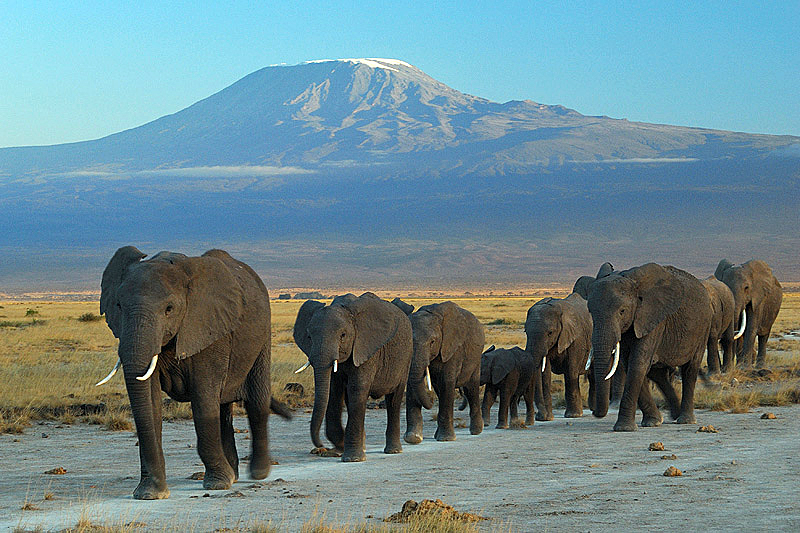
As for what we'll see, naturally we're going to enjoy the spectacle of the Great Migration, but in introducing our friends to Kenya we'll see lots more, including the spectacular scenery (lots of photos of that as well, in the 2009-2010 blog posts here at the personal blog). And Mr. Guy will of course take his pals to see his elephants, especially at the Amboseli National Park - in the shadow of Mt. Kilimanjaro. [And no, we won't be climbing Mr. Kilimanjaro - I've wanted to do that for years but there are a very practical couple of reasons I've not done it: 1) I'm not really a climber and 2) I can't find anyone who will train with me for the time required, so I've come to realize that Mr. Guy's climb up Mt. Kilimanjaro will remain in the realm of fantasy!]

But there's more at Amboseli, although it will be probably the elephants that will have my attention. As it turns out (I don't know why) Amboseli is the one area of Kenya where the elephants have lived somewhat protected lives, and many of the animals are very old indeed. Very old and, as far as any of us visitors can tell, very gentle. The poaching that is ravaging Africa (and even taking place in Kenya, to some degree, even though Kenya seriously outlawed elephant poaching about ten years ago) does not seem to have made its way into Amboseli, making this park absolutely perfect for two spectacular game drives a day. And we intend to take full advantage of them.

We'll also have game drives at the Nairobi National Park, the Tsavo East and Tsavo West National Parks, have a drive through the beautiful tea country to get to Kisii (where we'll see more friends and other members of our Kenya family), and visit the museums and some of Kenya's historic sites in and around Nairobi. We're having a splendid adventure!

Come August, watch this space. [But don't be disappointed if there isn't be much written before then - I'll do what I can but I expect I'm going to be pretty busy!]

Sunday, June 16, 2013

Much to see in San Diego


With a new camera and off on a business trip to one of America's most beautiful places, I had a good time in San Diego last week.

Before I get too far away from the trip I want to note a couple of monuments I've observed on previous visits, both of which I got to see again this time. It makes me very happy to share these with friends and colleagues.

San Diego - long an important center for U.S. Navy operations - is the site of the museum build around the U.S.S. Midway, and there's no denying that it's an important ship for a visit (particularly when you've had a little bit of American history and you understand the role the Midway played over the years). It's an amazing space, this ship, and when you stop to think that more than 225,000 sailors have been assigned to the ship, walking its decks is an awesome experience. Commissioned just after the end of World War II, the U.S. Midway was for many years the largest ship in the world.

In the shadow of the Midway are the two monuments I refer to in the title, a huge statue based on one of the most famous photographs of the war, taken during the victory celebration in New York's Times Square. The iconic photograph, turned into a massive sculpture for San Diego, honors all the nation's servicemen and makes it clear that they had every right to be celebratory when they came home.

A second monument honors longtime comedian and star Bob Hope (1903-2003), who spent much of this career supporting the nation's troops and traveling wherever he needed to go to entertain the country's service personnel. This sculpture depicts one such occasion, with an appreciative audience made up of members from all branches of the United States armed forces.

So a quick immediate impression of San Diego begins right next to the U.S.S. Midway and very naturally sets up a happy and wholesome mood for enjoying the beautiful city. Go here to see a few of my photos of the monuments.

Thursday, May 23, 2013

Information and Knowledge Strategy: No Longer an "Emerging" Management Methodology


Tuesday, May 21 was Class Day 2013 at Columbia University's School of Continuing Education, a splendid event for everyone affiliated with the school and its programs, including its graduate degree programs. Program directors introduced more than 500 candidates for degrees, giving us a grand opportunity to watch them walk joyfully across the stage to be greeted by Dean Kristine Billmyer. And the mood of the day was described perfectly by one of my faculty colleagues in the academic procession, when he remarked, "On a day like this! Isn't it great to be part of so much happiness?"

Well said.

Among the candidates were the first-ever graduates of Columbia University's M.S. in Information and Knowledge Strategy (IKNS) program, created in 2011 to provide professional education within (and matched to) Columbia's rigorous academic excellence in its many other programs.

Those of us affiliated with the program
(including fellow faculty member Anne Kershaw and Academic Director Katrina Pugh, pictured with me at right) were feeling particularly celebratory because the graduation of the IKNS 2012 Cohort marked the introduction of a special group of knowledge workers into the management community. With the successful completion of their studies during the 16-month program (with three onsite residencies on the Columbia University campus), the IKNS graduates are now prepared to take on knowledge leadership roles in their companies and organizations. They've studied a wide array of carefully chosen subjects to prepare themselves as knowledge "thought leaders" for the companies where they're employed (or for their new positions, for those graduates moving into different jobs now that they've completed their studies).

Graduation from the IKNS program requires proven expertise, and a simple listing of the required courses makes it clear that these graduates have mastered what they need to know to be knowledge strategists in the business and professional world:
  • Information and Knowledge in the 21st Century Economy
  • Management and Leadership in the Knowledge Domain
  • Findability and Innovation with Information and Knowledge Assets: Fundamentals and Business Cases
  • Enterprise-Wide Applications and Project Management
  • Business Analytics and Strategic Intelligence
  • Networks and Collaboration: Issues and Methods
  • Information Policy and Regulatory Issues
These courses - plus electives in related subjects and the Master's Capstone Project - ensure that Columbia's IKNS graduates are prepared to take their place in the increasingly (and dramatically) demanding world of information and intellectual capital management. Employing companies and organizations have made it clear that they stand to benefit from the expertise these graduates acquired through the IKNS graduate program.

So it's a good day for all of us involved in Columbia's IKNS program. For some years now, those of us working in the knowledge domain had found ourselves referring to information and knowledge strategy as "the emerging management methodology." No more. With these graduates - and IKNS graduates to follow - KM, knowledge services, and knowledge strategy are now embedded in the management arena. These graduates - one and all - are ready to put their knowledge and their expertise to work for their employing organizations, for their profession, and for the greater good. It is a very special time to be moving into this critical field of work.


Saturday, April 27, 2013

"Making Tracks for Elephants" at the Bronx Zoo


And Many Thanks to All Who Supported Mr. Guy's Elephant Walk 


While we are all struggling with the realities of the great tragedy that has come to the African elephants, it was extremely gratifying to see so many people participating in the Wildlife Conservation Society's "Making Tracks for Elephants" Run and Walk at the Bronx Zoo today.


But you thought it was "Mr. Guy's Elephant Walk" didn't you? Well, a little personal note: when I made my appeal, I used that reference as a not-too-successful play on the title of an Elizabeth Taylor movie from my childhood. Well, it didn't work. No one remembers the movie ("Elephant Walk") and, besides, it took place in Ceylon or some such place, not in Africa.


So not a good gimmick for getting people to support your favorite cause, Mr. Guy.

No matter. We did very well, and while I haven't yet heard from the folks at the Wildlife Conservation Society about how much was raised by all participants (I suppose that will be in the press sometime next week), I am very grateful to Mr. Guy's friends and family. We contributed nearly $1,700.00 to this important cause, and our donations will go far in funding more research about the elephants and, particularly, in trying to figure out how we can influence African governments to take serious action against the criminals who are poaching elephants for their ivory.

How bad is the poaching? Re-read the posts I sent out with my appeal, one on March 17 and another last week. Or read this from the WCS:


"If we do not act, we will have to shamefully admit to our children that we stood by as elephants were driven out of existence.”-- WCS conservationists Samantha Strindberg & Fiona Maisels, writing in The New York Times

"Alarming reports from the Central African Republic (CAR)  indicate a new spike in elephant killings, as poachers infiltrate areas once considered safe havens. This latest crisis is occurring near the Dzanga-Sangha protected areas, a World Heritage Site.

"Across the globe, elephants are vanishing. Up to 30,000 elephants are killed in Africa each year for their ivory tusks, which are in demand in Asia. Well-funded and well-armed criminal cartels are to blame. To combat them, we're scaling up our ecoguard programs and monitoring elephants in some of their last wild strongholds, building on our hundred-plus years of wildlife conservation expertise."


So to one and all who responded to M. Guy's appeal, my since thanks. Let's keep thinking about this important work, and talking about it with our friends and neighbors.

And once again, to all of you who contributed, I very much appreciate your taking the time to respond, and for your generous and kind contributions.

We did our part, and I'm very proud of you all.

Thank you very much.

Wednesday, April 24, 2013

Join Me in My Next Public Webinar


Mark your calendar now to join me on May 7 for an exclusive free webinar sponsored by Soutron Global.

In addition to my work with SMR International, I am the Consulting Specialist for Knowledge Services for Soutron Global. I am extremely pleased to be providing webinars sponsored by Soutron Global as part of my work with the company.

Soutron Global’s corporate mission is to transform libraries into the digital information resource centers of the future, and Soutron Global leads the way in assisting specialist librarians and other strategic knowledge professionals as they make the transition.

Our first webinar—“Transforming Libraries: Knowledge Expertise=Knowledge Effectiveness” focused on the role of the knowledge professional in the transformation process (go here to access the PPT slide deck).

We are looking forward to another good discussion on May 7, when we'll speak about “TRANSFORMING LIBRARIES: What’s Required?”

I’m very honored that Tony Saadat, Soutron’s President and CEO, has invited me to conduct the current series of webinars. Tony and I have worked together for many years, and for the Transforming Libraries Webinars, we’ve put together a full line-up of critical topics to discuss with friends, clients, and colleagues over the next eight months.

On May 7, in our webinar on “TRANSFORMING LIBRARIES: What’s Required?” we’ll dive deep into some of the major issues you’re thinking about, and we’ll address the following questions:
  1. What is the governance "picture" for sharing knowledge in your organization? Who owns the content?
  2. Does your system allow for integrating this knowledge into the organizational workflow?
  3. Can you and your team -- with the tools you have -- operate the specialized library as the company's knowledge nexus?
During our one-hour session, the Soutron Global team will also showcase the company’s cost effective enterprise library solutions to demonstrate how you can enhance the economic value of your knowledge assets and improve personal productivity while reducing operating costs. After the demonstration, a question-and-answer session will conclude our time together.

Webinar:              “TRANSFORMING LIBRARIES: What’s Required?”
Date:                     Tuesday, May 7, 2013
Time:                     2:00pm EST (11:00am PST)           
Venue:                   GoToWebinar

Please RSVP to reserve your place. Register on Soutron Global’s Webinar Registration page, as there are limited seats available. You will receive a GoToWebinar invitation with instructions in a separate email prior to the session.

Save the Elephants: One Last Appeal from Mr. Guy


By now you've seen what I've written about this on my personal blog, with the entry entitled Guy's Elephant Walk - Let's Save the Elephants.

I'm using the blog to invite people to join me in supporting the Wildlife Conservation Society in its work to save the elephants and to stop the awful poaching, and I hope you will support this work, too.

For my part, I will be participating in the WCS Run for the Wild on Saturday, April 27 (I'll be walking - I'm not a runner).

Please join me in contributing to this important fund. We've done very well with our campaign, but we can use more contributions.

If you want to know more, go directly to the blog post or, if you prefer, just go directly to my appeal, which is published on the Wildlife Conservation Society's site.

And here's one last thought: I heard this quotation recently, and as a grandfather of six granddaughters and one grandson, it really spoke to me:

"The question is, are we happy to suppose that our grandchildren may never be able to see an elephant except in a picture book?" (David Attenborough)

Think about it.

Please join me in supporting the Wildlife Conservation Society as we seek to learn more about the elephants and try to figure out how to stop the poaching.

Sunday, April 21, 2013

A Personal Appeal From Guy - Let's Save the Elephants


Many of my friends and colleagues have already heard from me about this, but I want to make one last appeal before the run at the Wildlife Conservation Society (Bronx Zoo) next Saturday.

Don't know if you're interested in this kind of thing, but I'm taking seriously the impact of all the poaching of the elephants in Africa.

It's now become a true epidemic, and I'm doing a little fund-raising here in New York.

I don't think I need to go into a lot of detail, for almost anyone who knows me knows how much I love Kenya and all our friends and our "Kenya family" there.

Kenya - and all of Africa - is in the grips of a horrible tragedy now, as gangsters have taken to slaughtering the magnificent elephants for the ivory.

I've written about this on my personal blog, with the entry entitled Guy's Elephant Walk - Let's Save the Elephants.

I'm using the blog to invite people to join me in supporting the Wildlife Conservation Society in its work to save the elephants and to stop the awful poaching, and I hope you will support this work, too.

For my part, I will be participating in the WCS Run for the Wild on Saturday, April 27 (I'll be walking - I'm not a runner). I invite you to join me in contributing to this important fund.

If you would like to know more, go directly to the blog post or, if you prefer, just go directly to my appeal, which is published on the Wildlife Conservation Society's site.

Thank you very much for thinking about this. And to give you a couple of images to show you why I love these magnificent creatures so much, here are two photos from the last time I visited the elephant orphanage in Nairobi. I had earlier written about the elephant orphanage here (the post includes a link to more photos, too). Please join me in supporting the Wildlife Conservation Society as we seek to learn more about the elephants and try to figure out how to stop the poaching.