Showing posts with label Kenya - Zebra. Show all posts

Thursday, December 30, 2010

Flat Stanley Goes to Kenya (5): Lake Nakuru National Park

We don't hear much about the flamingos in Kenya, and Flat Stanley got pretty excited when I told him that we could see thousands and thousands of flamingoes in Lake Nakuru National Park. I went there last year on a safari, and I was amazed at how many flamingoes there (I wrote about the park - and the flamingoes - in a couple of posts that you can check out if you like, here and here and here).

So when I told Stanley that we were going to see the flamingoes, he began to jump up and down and I got a little nervous because he can jump so high I was afraid a gust of wind would sweep him away. Stanley can jump even higher than the Maasai dancers we visited in Masai Mara (I'm not sure they liked that very much, and it seemed to make them a little nervous.

Going to Lake Nakuru and other places up in the Nakuru area was a big safari for us. Not only was it Mr. Andrew and Mr. Charles and I - just like the trip with Stanley to Masai Mara - we would be joined by Ms. Nerisa and Mr. Geoffrey - our Kenyan friends - and Mr. Richard and Mr. John, who had come from America to be part of the safari. So there was a big gang of us, and we got up very early to make the journey from Nairobi to Lake Nakuru, about three hours away.

The experts tell us that there are more than 500 species of birds listed for Lake Nakuru, and you can believe it, because they are all over the place. But the flamingoes are the best (there are over 2 million of them at the lake at any given time!), and sometimes one whole section of the lake will be just totally pink with the colors of the so-called "Greater Flamingo" (there are also plenty of the so-called "Lesser Flamingo," which are a tiny bit smaller and have feathers that are more white and less pink, if you're interested in that fine distinction). They all mingle together at Lake Nakuru, along with a large number of pelicans, probably more than Stanley and I have ever seen in any one place in America.

A special treat at Lake Nakuru is also the mingling together of the zebras and the waterbucks. The latter is large animal, one of the large antelopes family, with a shaggy grey-brown coat. When they are mixed up with the striped zebras, as one of them is in this group of waterbucks and zebras looking at Stanley, it's a very pretty picture.

Sunday, September 5, 2010

Africa: The Migration (4) - The Wildebeests and the Zebras

The Best Four came on safari to see the Great Migration and we certainly were not disappointed. We'll get to the numbers later, as we try to describe our adventures with finding the animals crossing the Mara River to continue their migration on up into the Kenya grasslands.

For the present, let's share some of what we saw on our first game drive. In addition to the elephant excitement of our afternoon, we saw much more, and addicted safari-goers that we are, we just couldn't get enough.

As noted in other posts, the migration is generally associated with the wildebeests (in some countries the Afrikaner pronunciation is used - vil'-de-beest - with the accent on the first syllable) and the zebras (sometimes - pretty often, as a matter of fact - referred to as zeh-bras instead of our American zee-bras), and here at Migration Safari - Wildebeests and Zebras are some photos of the first herds we saw. Often the African buffalo gets mingled in, but I think that's just because they were already onsite and were enjoying the juicy grass before the wildebeests and the zebras migrated from the Serengeti to join them. Some authorities make a big deal about other travelling companions, such as the Thomson's gazelle, Grant's gazelle, topi, Coke's hartebeest, and eland, but it's the wildebeest that makes up the numbers, along with the many beautiful zebra that join them for the journey.

Also known as the blue wildebeest (I suppose because of its grey-brown coat), this member of the antelope family is a funny looking animal. The long, spindly legs give it an odd shape and seem hardly capable of supporting the wildebeest's upper frame. On the other hand, it's not a heavy animal, and I'm always surprised to see how thin the animals' upper body is, how slightly built the animal is. Another distinctive feature is the shaggy beard, which makes for some silly remarks from time to time amongst safari-goers. Known as a very gregarious animal, it's not surprising that the wildebeest herds travel together in the migration as they head for better feeding grounds. But that characteristic gets shoved aside a little as the migration moves forward. For some reason, as the animals go toward their new grazing grounds, the wildebeest move "into formation," positioning themselves into a single file, a line of moving animal bodies that can go on for the longest time (reminding me of my childhood in Virginia, watching the long freight trains moving forward, sometimes with a couple of hundred boxcars). My friends and I didn't try to count the wildebeest, but it was clear that any one line could have several hundred of them, only herding together and bunching up when there was some impediment to moving on. Very curious.

We have two types of zebras in Africa, and from what I can tell from my photographs, what we're seeing are the ones known as the Plains Zebra (sometimes called Burchell's Zebra), since their striping goes right around under the belly. the Plains Zebras are all over the place, from Ethiopia to South Africa.

The other species, Grevy's Zebra, has a different look, with narrower striping that stops when it gets to the animal's belly, leaving a broad white expanse under the zebra. Sadly, the Grevy's Zebra is now found almost exclusively in Northern Kenya, and their numbers are diminishing, down to between 1,000 and 2,000 animals according to one count.

The fact most people remember about zebras - aside from their simple equine beauty - is that each stripe is as distinctive as a human fingerprint. I'm impressed about how they always seem to show up with other animal groups, and from our earliest safaris our group has been surprised to see zebras in or near the herds of elephants, giraffes, and other groups we run across. They seem to be very affectionate animals, and it is not at all unusual to see them nuzzling each other as they go about their grazing.

Enjoying the zebras as much as I am, I think I shall re-focus a little as I continue to build my knick-knacks collection at my flat in New York. Although I'm not a rider, for years I have admired the shape of the horse and I have a tiny collection of sweet horse statuettes I've gathered during my travels (or that people have given to me). Doesn't the collection need some zebras now? I thought I had completed my African souvenir shopping a long time ago, but these beautiful zebras might inspire me to head back into the shops.

Friday, June 4, 2010

Nairobi Nat'l Park - Enda Salama

So I guess the final safari photos (for this visit to Kenya) are now done, and I'm happy to share Mr. Guy's Nairobi Nat'l Park (2) Album as a sort of last look for friends and colleagues who have been enjoying these postings. A nice sort of "final look," if you will. Mostly African buffalo, zebras, and giraffes, but now it's time to say good-by to the adventure of a lifetime.

There will be more safaris. No question of that. Probably not during my August visit to Kenya, as that is planned for some pretty serious and probably very intensive professional work, and there won't be time to get away. But December is already planned, with two friends determined to share some of what Mr. Guy experienced during these past six months (and perhaps others joining us as well - we'll see).

As for how we'll organize our December safari, we've got it all worked out, and what we're putting together makes a lot of sense. And we are, in fact, doing very little ourselves.

Having discovered that in addition to being Mr. Guy's driver par excellence Charles Masese is also skilled as a tour guide and organizer,we are turning to him for future safari planning and guiding. And anyone else who wants to contact him, (charlesomasese@gmail.com) is welcome to do so. You will find a joyful and very competent welcome to Nairobi - the man is really good at what he does and I heartily recommend Charles Masese for his work. He is in charge (my favorite words are when Charles says, "Leave it to me" - in six months I've never been disappointed!).

And I am already looking forward to the December safari with my friends. And to have him "taking care" of me (a phrase used in Kenya a lot) whenever I'm in Nairobi or environs, I've come to know Charles and experience his competence. I'm very happy to recommend him.

Whether during the December safaris (and there will be several, and probably none more than two nights away from Nairobi, which does seem to serve as the safari "capital" of Africa), we'll have an "historical" sighting or not is something that cannot be predicted. As I think I've pointed out several times, the idea of a game drive is primarily that one has the potential to see the wildlife, but there are no guarantees. But if we can experience even some of the beauty of what I've enjoyed over the past six months, we (and anyone else who comes to Kenya for a safari) are going to indeed have the adventure of a lifetime. Enda Salama.

Friday, May 28, 2010

Masai Mara (13): An Historic Sighting

While I had made it clear to Charles and to Tomas that I would dearly love to see more elephants, as many as we could fine, I was pretty comfortable with the idea that one doesn't necessarily see what one expects (or wants) to see on a safari.

So I was pretty satisfied with our previous sighting, and if that had to be the extent of my elephant viewing, I would not allow myself to be disappointed. That was a magnificent animal and even though, while early on in our visit with him we speculated about why he was out there all alone (even wondering if he were ill or indisposed in some way), Tomas assured us that it is not unusual for a single elephant - especially a male - to be out by himself. And I knew a little of that, for in my readings I had come across one author who commented about how males are generally "invited" to leave their birth group when they are in their early teams. While some of them roam about in bachelor herds, it's not at all unusual to see a male by himself. After all, he's hardly in any danger, with all his bulk, and except for the humans (especially the poachers, but they are pretty much on the wane now, particularly in Kenya where there is a "shoot-to-kill" law for poachers caught in the act), I don't think the male elephants have much to worry about.

Which leads us to what had to be one of the most remarkable days of my life. We were out on an afternoon game drive, and we had already seen some lions and even a big ol' rhino over on the top of a hill, too far away to photograph. But there didn't seem to be much else about (except, as always, the impala, the African buffalo, the wildebeest - they're always around!).

So we just kept on driving, leaving the track when we wanted to and meandering on across the grass on several occasions. There were very few people out on game drives this afternoon, and only a few vans and 4WDs could be seen from time to time, so we ourselves were pretty much on our own.

And yes, from time to time one of us would comment about how nice it would be to see some more elephants. And in fact Tomas did spot a herd quite a distance away, deep in the forest, but we could hardly see them they were so far. Then Charles saw a herd off in another direction. These, too, were very far away, and there was a lot of grassland between us and them, and some pretty deep ravines, but they looked pretty inviting. So we didn't debate long.

"Hey, guys, we're in this for some adventure. Let's go for it."

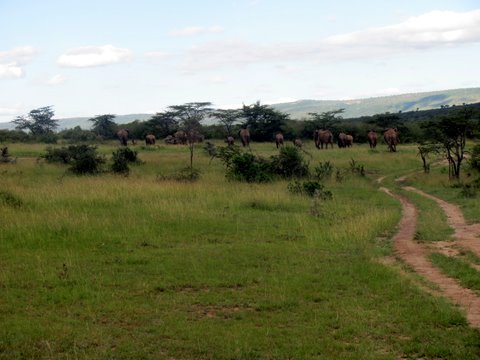
So Mr. Charles took out across the grass, with the van bumping and jumping all along the way, and Tomas and me standing in the back and holding on for dear llife. We were way off the track by now, but as we began to climb slowly up the other side of the ravine, where the grass was much shorter, there up in front of us was one of the most magnificent herds of elephant I could ever hope to see. We drove up a little nearer, turned off the engine, and just sat there and feasted our eyes.

Pretty soon the herd began to wander off into the forest, and lo and behold! There was another huge herd (we're talking about 12-15 adults and who knows how many calves?), off on the other side. Then a big bull (massive - probably one of the biggest elephants I've ever seen) went off by himself, into a different part of the woods, and as we watched him move away, we realized that there in front of us, off in the clearing, was a huge herd of giraffe, all coming out of the trees one at a time, looking around, them coming out into the open area. We drove over a little closer, again turned off the engine, and just sat there.

Soon more giraffes, more elephants, and of great surprise to us, zebras. I tried to keep taking pictures but it was hard. I was just too excited, but some of what I took - probably far too many! - are here at Mr. Guy's Masai Mara (13) Album.

And it was an amazing spectacle. It was as if we were at some sort of elephant-zebra-giraffe show, and we were surrounded on all sides. And off to the right, Mr. Big Bull was having himself a grand old time, snapping off trees so he could get to the juicy leaves at the top of each one.

We hadn't thought about it, but as we were parked in a clearing, we could easily be observed by the other tour vehicles on their own game drives, and pretty soon two or three other vans drove up to join us. All the drivers and guides know the rules of the road, of course, and they all thanked us as they came up alongside, and we all sat quietly, saying little to one another but sharing some good stories and observations. We even starting counting the animals, but I soon last track (Charles counted the giraffes, and he got up to 38 before he stopped!).

It was a remarkable experience, and as the afternoon began to wind down - and we knew we would have to get back to the road before dark - would want to get back to the road before dark, we quietly said our good-byes to the other guides and tourists. And one fellow, who looked like he could have come out of a 1950s Hollywood film about the tough old guide who leads the great white hunter around, really surprised us.

"I've been doing this a long time," he said. "I've never seen anything like this. This is historic."