Often referred to as "the most characteristic" of Africa's water animals, the lumbering hippopotamus is truly a wonder to see. Because they tend to stay mostly submerged most of the time (thanks to having their ears, eyes, and nostrils high up on their head) and do their grazing at night, we kind of forget just how many of these big guys there are around.
On our migration safari, The Four Best Friends were lucky to see hippos twice. On our first attempt at observing a crossing over the Mara River - the one when the wildebeests and zebras were not cooperating and took a couple of hours to decide not to cross - we were lucky to see, from our distant vantage point, a single lone fellow far away across the terrain. That was kind of unusual we thought, but our guide explained that the hippo is often found along, wandering off from his or her pod just to graze and then catching up with the rest of the gang (which can be up to 30 hippos) as dusk begins to fall.
In any case, we didn't see any others, but it was good to see him at the distance, beyond a line of wildebeests still debating whether to cross or not. The zoom shot at Migration Safari - Hippos isn't very clear, but I was trying to get some sense of the size of these enormous herbivores: up to six feet (150 cm) at the shoulder, and weighing in at nearly 4,500 pounds (2,000 kg). But we have to not give in to temptation and think their size keeps them from moving; I've seen it written that the common hippopotamus can attain speeds of up to 20 mph (32 kmph) and because it heads straight to the water when when it is disturbed, human beings are warned to stay far out of its way, as the hurrying hippo will cut down anything in its way as it moves to the water.
As it turns out, Geoffrey had better luck with his later photos of the hippos in the river, and his pictures really give a sense of the size of these animals. We came upon this small pod - resting in the sun - a little later in the day and even from this distance, we could hear the distinctive grunting sound the animals make. In the water or out, they let you know they are about, and if you happen to be staying in a lodge or campsite near the water when you're on safari, you hear the sound all day long and, especially, all night long. One of the expected sounds of the forest, and you get used to it (and by the way, if I have not mentioned it before, the Kenyans seem to all use the word "forest" instead of "jungle," reserving the latter for the rainforest-type setting).
Showing posts with label Kenya - Masai Mara Game Reserve. Show all posts
Thursday, September 16, 2010
Thursday, September 2, 2010
Africa: The Migration (3) - Our Safari and Our First Elephants
The Best Four took off for Masai Mara to see the migration, and we were hardly out of the campsite and into the game reserve before we were amazed at the numbers of wildebeests, zebras, and other migrating animals that had made their way to this magnificent grassland. We were immediately excited, and expected to spend quite some time driving around looking at all the animals that had come looking for food (and yes, probably more than those two-and-a-half million talked about by the experts), but we had an immediate distraction. And our first adventure.
When my pal Tom Rink read my first post about the up-coming safari to see the migration, he had written: "I think this would be awesome to witness, but don't get too close!"
So guess what we did on our first afternoon. We got too close!
Okay. Perhaps we are a little over-awed about elephants, and I'm happy to admit that of all the animals I see, it's the elephants that sort of win my heart. So even though we weren't particularly looking for elephants as we moved into Masai Mara in the mid-afternoon, Mr. Charles - elephant-spotter extraordinaire that he is - had hardly driven twenty minutes before he suddenly turned off the road, off the tracks, and was moving slowly and carefully down toward a gully and up the other side. He admonished us to be quiet and as we drove across the grass (now very short - unlike the visit last May, when it was shoulder-high, the grass now having been "mowed" by the many wildebeests and others who had come north looking for it), it was obvious we were heading for something special.
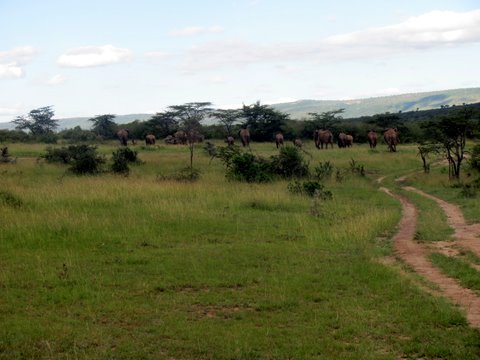
Charles got us back on another track and we moved - still as quietly as we could move - up the hill to what he had spotted: as you can see in the first photo at Migration Safari - Our First Elephants, we saw - we thought - a single elephant munching away at some green branches in the bush.
So we drove a little closer, turned off the engine to watch a while, and we were surprised to discover that it was not just one big bull elephant but apparently a group. It had been a trick of the light and the placement of their enormous bodies that had tricked us into thinking it was just one elephant, so not wanting to disturb them, we switched the engine on again and began to move slowly on the track (you can see how close we got in the photo showing the track).
It was then that we realized we had perhaps made a pretty serious mistake. At this point Mr. Elephant began to look up at us, not pleased with our being so near, and as we looked to the right, that big brown blob - which we had assumed was a rock or a big tree or something (we obviously had not paid any attention to it) was in fact a young elephant. We were suddenly not too happy to be there, and as Charles put the vehicle into reverse, we saw that Mr. Elephant wasn't very happy either, and he was moving in our direction. Those elephants milling about behind him - which we had first thought were just him alone - were in fact his family. For all we knew Mrs. Elephant was there as well and who knows how many other young ones - perhaps from other families as well - were there in that herd. We tried to move away gently, and we were really frightened now, for Mr. Elephant was clearly moving in our direction. In fact he was getting pretty close, but I couldn't resist one last zoom shot - determined as always (and foolishly I now realize) to try for one memorable picture.
It was memorable all right, and muttering to ourselves about all the stories we had heard about how fast an elephant can move - and remembering that we had (accidentally, to be sure) broken one of the inviolate rules of game by coming too close to a parent's little one - we got away as fast as we could. We other three kept looking back while Charles drove across the grassland, gradually picking up speed until we got past the ravine and up the other side. Now we could see that Daddy Elephant had turned around and gone back to join his family, so we felt safe, and we all promised not to get too close for the rest of the safari.
When my pal Tom Rink read my first post about the up-coming safari to see the migration, he had written: "I think this would be awesome to witness, but don't get too close!"
So guess what we did on our first afternoon. We got too close!
Charles got us back on another track and we moved - still as quietly as we could move - up the hill to what he had spotted: as you can see in the first photo at Migration Safari - Our First Elephants, we saw - we thought - a single elephant munching away at some green branches in the bush.
So we drove a little closer, turned off the engine to watch a while, and we were surprised to discover that it was not just one big bull elephant but apparently a group. It had been a trick of the light and the placement of their enormous bodies that had tricked us into thinking it was just one elephant, so not wanting to disturb them, we switched the engine on again and began to move slowly on the track (you can see how close we got in the photo showing the track).
It was then that we realized we had perhaps made a pretty serious mistake. At this point Mr. Elephant began to look up at us, not pleased with our being so near, and as we looked to the right, that big brown blob - which we had assumed was a rock or a big tree or something (we obviously had not paid any attention to it) was in fact a young elephant. We were suddenly not too happy to be there, and as Charles put the vehicle into reverse, we saw that Mr. Elephant wasn't very happy either, and he was moving in our direction. Those elephants milling about behind him - which we had first thought were just him alone - were in fact his family. For all we knew Mrs. Elephant was there as well and who knows how many other young ones - perhaps from other families as well - were there in that herd. We tried to move away gently, and we were really frightened now, for Mr. Elephant was clearly moving in our direction. In fact he was getting pretty close, but I couldn't resist one last zoom shot - determined as always (and foolishly I now realize) to try for one memorable picture.
Tuesday, August 31, 2010
Africa: The Migration (2) - The Four Best Head Out
We've taken to calling ourselves "the four best," since we like to think our our little group as The Four Best African Friends. Not sure it works, 'cause I have so many best friends in Africa that it is difficult for me to decide who are "the best."
But no question about it, these are the people I hang out with most, and we have our fun.
What we're calling ourselves connects, I suppose, to the phrase used by many people who come to Africa to go on safari (and it's how we came up with it, as we thought about what people look for on safari). It's traditional to make a big deal of looking for "the big five" (African buffalo, African bush elephant, leopard, lion, and rhino). Why not? It's not a bad idea to have some focus for your search as you ride about looking for wildlife. Still, there is so much else to look for that it seems a little gratuitous to give so much attention to just five animals.
The Four Best's Migration Safari began last Friday, a big day in Kenya. It was a national holiday, and since it seemed a good idea to be away from all of the crowds in Nairobi, we chose that day for beginning our migration safari. I wrote about the migration phenomenon in the last post, so won't go into detail about the Great Migration now, except to say that it was a great excuse for taking off and heading back to Masai Mara, the huge game reserve some of us had visited before (a safari described in lots of posts back in May - click on "May" in the archives list to the left).
But we couldn't just leave our patriotism at home, so when we stopped for petrol, we saw a display of little flags and decided we had to have one attached to the car - Charles's job! Lots of fun, attracting attention both at the early morning hour and after we got into the game reserve.
This safari was a little different, as this was to be my first tent safari. Not a bad way to do a safari, and certainly a pleasant way to get to meet other people, since most campsites have several tents in the compound and campers share a common dining tent for meals (some photos are here). Nice conversations and getting to know new people around the big bonfire before dinner, that sort of thing.
Once again I was the only muzungu in the crowd, a distinction that seems to elude me here in Kenya, but afterwards I'm always surprised (and pleased) when the subject comes up and I realize that none of us even thought about it. Kenyans just don't worry about such things, and certainly our little group is now so tight-knit that we have many other subjects to discuss.
Like all the animals we saw. Stay tuned for more (and more photos).
But no question about it, these are the people I hang out with most, and we have our fun.
What we're calling ourselves connects, I suppose, to the phrase used by many people who come to Africa to go on safari (and it's how we came up with it, as we thought about what people look for on safari). It's traditional to make a big deal of looking for "the big five" (African buffalo, African bush elephant, leopard, lion, and rhino). Why not? It's not a bad idea to have some focus for your search as you ride about looking for wildlife. Still, there is so much else to look for that it seems a little gratuitous to give so much attention to just five animals.
The Four Best's Migration Safari began last Friday, a big day in Kenya. It was a national holiday, and since it seemed a good idea to be away from all of the crowds in Nairobi, we chose that day for beginning our migration safari. I wrote about the migration phenomenon in the last post, so won't go into detail about the Great Migration now, except to say that it was a great excuse for taking off and heading back to Masai Mara, the huge game reserve some of us had visited before (a safari described in lots of posts back in May - click on "May" in the archives list to the left).
But we couldn't just leave our patriotism at home, so when we stopped for petrol, we saw a display of little flags and decided we had to have one attached to the car - Charles's job! Lots of fun, attracting attention both at the early morning hour and after we got into the game reserve.
This safari was a little different, as this was to be my first tent safari. Not a bad way to do a safari, and certainly a pleasant way to get to meet other people, since most campsites have several tents in the compound and campers share a common dining tent for meals (some photos are here). Nice conversations and getting to know new people around the big bonfire before dinner, that sort of thing.
Once again I was the only muzungu in the crowd, a distinction that seems to elude me here in Kenya, but afterwards I'm always surprised (and pleased) when the subject comes up and I realize that none of us even thought about it. Kenyans just don't worry about such things, and certainly our little group is now so tight-knit that we have many other subjects to discuss.
Like all the animals we saw. Stay tuned for more (and more photos).
Friday, August 27, 2010
Africa: The Migration
Sometimes referred to as "The Great Migration" or the "Wildebeest Migration," most people in Africa simply speak of this incredible natural phenomenon as "The Migration."
The sheer scope of this animal trek is, quite frankly, hard to believe for many people. How could so many animals know to come together to move about the continent? With the migration in Africa, it seems we are seeing perhaps the grandest ever example of what is commonly referred to (in other circumstances) as "the herding instinct."
It's not a quick event by any means. Starting in the May-June period, this annual migration of some two and a half million animals (by some estimates) begins in the Serengeti, in Tanzania, as the wildebeest, zebras, gazelles, and antelope begin to move out of the drying grass in search of richer and more plentiful grasses farther north and west. They'll cross the dangerous Grumeti river, where many of the animals drown and others are attacked by the huge crocodiles waiting for them. The survivors - still huge in number - will head on up to the Masai Mara, there to attempt to cross the Mara river into Kenya, but predators are waiting for them there as well and they seem to know it, with thousands of them sometimes waiting on the riverbanks for up to two weeks at a time before plunging into the river. Several hundred will be devoured but as they die, they make the way relatively safer for those that have been waiting, leaving them free to move on across the river and up into the Masai Mara Game Reserve, where they will spend two or three months moving about across the beautiful grasslands of that treasured part of Africa.
By September, the animals will have had enough of the green grass of the Masai Mara, and they will begin their long journey back into the eastern Serengeti, where they will remain until April or so, before getting the signs from nature that it's time to head back north and west again.
Called by some "the world's greatest natural spectacle," the migration just goes to prove, once again, that the bounties of the earth are still valuable for the most elementary of needs. It's a special kind of joy just to think about what the sight must be, to see these incredible millions of animals moving so far in search of their own version of "the good life."
The sheer scope of this animal trek is, quite frankly, hard to believe for many people. How could so many animals know to come together to move about the continent? With the migration in Africa, it seems we are seeing perhaps the grandest ever example of what is commonly referred to (in other circumstances) as "the herding instinct."
It's not a quick event by any means. Starting in the May-June period, this annual migration of some two and a half million animals (by some estimates) begins in the Serengeti, in Tanzania, as the wildebeest, zebras, gazelles, and antelope begin to move out of the drying grass in search of richer and more plentiful grasses farther north and west. They'll cross the dangerous Grumeti river, where many of the animals drown and others are attacked by the huge crocodiles waiting for them. The survivors - still huge in number - will head on up to the Masai Mara, there to attempt to cross the Mara river into Kenya, but predators are waiting for them there as well and they seem to know it, with thousands of them sometimes waiting on the riverbanks for up to two weeks at a time before plunging into the river. Several hundred will be devoured but as they die, they make the way relatively safer for those that have been waiting, leaving them free to move on across the river and up into the Masai Mara Game Reserve, where they will spend two or three months moving about across the beautiful grasslands of that treasured part of Africa.
By September, the animals will have had enough of the green grass of the Masai Mara, and they will begin their long journey back into the eastern Serengeti, where they will remain until April or so, before getting the signs from nature that it's time to head back north and west again.
Called by some "the world's greatest natural spectacle," the migration just goes to prove, once again, that the bounties of the earth are still valuable for the most elementary of needs. It's a special kind of joy just to think about what the sight must be, to see these incredible millions of animals moving so far in search of their own version of "the good life."
Saturday, May 29, 2010
Masai Mara (14): Sunday Elephant
Charles and I planned our final game drive for Sunday morning, since the Sekenani Gate, where we had entered the Masai Mara Game Research and from which we would leave, was quite some distance from the Sopa Lodge and it wouldn't make sense to circle back around. So we decided I would check out of the lodge after breakfast (complete with monkey entertainment, which I described in an earlier post) and we would take a nice leisurely game drive through a big chunk of the game reserve.
As we would not be having Tomas with us on this game drive, we had said our good-byes the previous evening, after he had very kindly gone back to his village and then returned (coming to us via a 15-minute or so walk through the forest in the dark - I can't figure it out!) to bring us our presents. This gesture surprised me, for we had bought some Maasai souvenirs when we were at the manyatta, including some very handsome beads (pretty typical but still very lovely), and we didn't expect to have anything else. But he was very good to do this for us, and I asked for his address so that when I return to Masai Mara with friends in December, we can try to have Tomas for our guide.
We were not really looking for anything in particular on our Sunday morning excursion, and after the experience of the previous afternoon's game drive, it would seem a little greedy, perhaps, to want to see more. And truth to tell, there were not a great many animals about, at least as far as we could see. But sharp-eyed Charles was not to be deterred. Just casually looking around as he drove along (we were still on the "main road," such as it is), he suggested we go off onto some different tracks, and we got lucky, as you can see here.
At one point, we cut across the high grass and made our way up a slope and around another curve and there, off in the distance, was our Sunday Elephant, having his mid-morning meal. He was quite a handsome fellow and we were not surprised to see him alone, since Thomas had earlier explained that phenomenon to us.
We drove to the top of the sloping hill and we found we were able to get quite close. We turned off the engine and - as had become our pattern now - just sat quietly and watched him. By playing with the zoom, we were able to get some neat pictures (ready for you at Mr. Guy's Masai Mara (14) Album - the final set of pictures from this safari).
Our Sunday Elephant. What a lovely way to end our safari to the Masai Mara Game Reserve! We stayed with him for a while, and in the final shot, taken just as we were moving away, Mr. Guy - ever the romantic - got the impression that Mr. Sunday Elephant was perhaps - like us - a little sad to see us leave.
But leave we must, so off we went to the gate, to head out of the game reserve and back to Nairobi. A fine way to bring our safari to its end! And as for the question about Mr. Guy's favorite animal, of all the wildlife he's seen? Well, I think that question has been answered now, hasn't it?
As we would not be having Tomas with us on this game drive, we had said our good-byes the previous evening, after he had very kindly gone back to his village and then returned (coming to us via a 15-minute or so walk through the forest in the dark - I can't figure it out!) to bring us our presents. This gesture surprised me, for we had bought some Maasai souvenirs when we were at the manyatta, including some very handsome beads (pretty typical but still very lovely), and we didn't expect to have anything else. But he was very good to do this for us, and I asked for his address so that when I return to Masai Mara with friends in December, we can try to have Tomas for our guide.
We were not really looking for anything in particular on our Sunday morning excursion, and after the experience of the previous afternoon's game drive, it would seem a little greedy, perhaps, to want to see more. And truth to tell, there were not a great many animals about, at least as far as we could see. But sharp-eyed Charles was not to be deterred. Just casually looking around as he drove along (we were still on the "main road," such as it is), he suggested we go off onto some different tracks, and we got lucky, as you can see here.
At one point, we cut across the high grass and made our way up a slope and around another curve and there, off in the distance, was our Sunday Elephant, having his mid-morning meal. He was quite a handsome fellow and we were not surprised to see him alone, since Thomas had earlier explained that phenomenon to us.
We drove to the top of the sloping hill and we found we were able to get quite close. We turned off the engine and - as had become our pattern now - just sat quietly and watched him. By playing with the zoom, we were able to get some neat pictures (ready for you at Mr. Guy's Masai Mara (14) Album - the final set of pictures from this safari).
But leave we must, so off we went to the gate, to head out of the game reserve and back to Nairobi. A fine way to bring our safari to its end! And as for the question about Mr. Guy's favorite animal, of all the wildlife he's seen? Well, I think that question has been answered now, hasn't it?
Friday, May 28, 2010
Masai Mara (13): An Historic Sighting
While I had made it clear to Charles and to Tomas that I would dearly love to see more elephants, as many as we could fine, I was pretty comfortable with the idea that one doesn't necessarily see what one expects (or wants) to see on a safari.
So I was pretty satisfied with our previous sighting, and if that had to be the extent of my elephant viewing, I would not allow myself to be disappointed. That was a magnificent animal and even though, while early on in our visit with him we speculated about why he was out there all alone (even wondering if he were ill or indisposed in some way), Tomas assured us that it is not unusual for a single elephant - especially a male - to be out by himself. And I knew a little of that, for in my readings I had come across one author who commented about how males are generally "invited" to leave their birth group when they are in their early teams. While some of them roam about in bachelor herds, it's not at all unusual to see a male by himself. After all, he's hardly in any danger, with all his bulk, and except for the humans (especially the poachers, but they are pretty much on the wane now, particularly in Kenya where there is a "shoot-to-kill" law for poachers caught in the act), I don't think the male elephants have much to worry about.
Which leads us to what had to be one of the most remarkable days of my life. We were out on an afternoon game drive, and we had already seen some lions and even a big ol' rhino over on the top of a hill, too far away to photograph. But there didn't seem to be much else about (except, as always, the impala, the African buffalo, the wildebeest - they're always around!).
So we just kept on driving, leaving the track when we wanted to and meandering on across the grass on several occasions. There were very few people out on game drives this afternoon, and only a few vans and 4WDs could be seen from time to time, so we ourselves were pretty much on our own.
And yes, from time to time one of us would comment about how nice it would be to see some more elephants. And in fact Tomas did spot a herd quite a distance away, deep in the forest, but we could hardly see them they were so far. Then Charles saw a herd off in another direction. These, too, were very far away, and there was a lot of grassland between us and them, and some pretty deep ravines, but they looked pretty inviting. So we didn't debate long.
"Hey, guys, we're in this for some adventure. Let's go for it."
So Mr. Charles took out across the grass, with the van bumping and jumping all along the way, and Tomas and me standing in the back and holding on for dear llife. We were way off the track by now, but as we began to climb slowly up the other side of the ravine, where the grass was much shorter, there up in front of us was one of the most magnificent herds of elephant I could ever hope to see. We drove up a little nearer, turned off the engine, and just sat there and feasted our eyes.
Pretty soon the herd began to wander off into the forest, and lo and behold! There was another huge herd (we're talking about 12-15 adults and who knows how many calves?), off on the other side. Then a big bull (massive - probably one of the biggest elephants I've ever seen) went off by himself, into a different part of the woods, and as we watched him move away, we realized that there in front of us, off in the clearing, was a huge herd of giraffe, all coming out of the trees one at a time, looking around, them coming out into the open area. We drove over a little closer, again turned off the engine, and just sat there.
Soon more giraffes, more elephants, and of great surprise to us, zebras. I tried to keep taking pictures but it was hard. I was just too excited, but some of what I took - probably far too many! - are here at Mr. Guy's Masai Mara (13) Album.
And it was an amazing spectacle. It was as if we were at some sort of elephant-zebra-giraffe show, and we were surrounded on all sides. And off to the right, Mr. Big Bull was having himself a grand old time, snapping off trees so he could get to the juicy leaves at the top of each one.
We hadn't thought about it, but as we were parked in a clearing, we could easily be observed by the other tour vehicles on their own game drives, and pretty soon two or three other vans drove up to join us. All the drivers and guides know the rules of the road, of course, and they all thanked us as they came up alongside, and we all sat quietly, saying little to one another but sharing some good stories and observations. We even starting counting the animals, but I soon last track (Charles counted the giraffes, and he got up to 38 before he stopped!).
It was a remarkable experience, and as the afternoon began to wind down - and we knew we would have to get back to the road before dark - would want to get back to the road before dark, we quietly said our good-byes to the other guides and tourists. And one fellow, who looked like he could have come out of a 1950s Hollywood film about the tough old guide who leads the great white hunter around, really surprised us.
"I've been doing this a long time," he said. "I've never seen anything like this. This is historic."
So I was pretty satisfied with our previous sighting, and if that had to be the extent of my elephant viewing, I would not allow myself to be disappointed. That was a magnificent animal and even though, while early on in our visit with him we speculated about why he was out there all alone (even wondering if he were ill or indisposed in some way), Tomas assured us that it is not unusual for a single elephant - especially a male - to be out by himself. And I knew a little of that, for in my readings I had come across one author who commented about how males are generally "invited" to leave their birth group when they are in their early teams. While some of them roam about in bachelor herds, it's not at all unusual to see a male by himself. After all, he's hardly in any danger, with all his bulk, and except for the humans (especially the poachers, but they are pretty much on the wane now, particularly in Kenya where there is a "shoot-to-kill" law for poachers caught in the act), I don't think the male elephants have much to worry about.
Which leads us to what had to be one of the most remarkable days of my life. We were out on an afternoon game drive, and we had already seen some lions and even a big ol' rhino over on the top of a hill, too far away to photograph. But there didn't seem to be much else about (except, as always, the impala, the African buffalo, the wildebeest - they're always around!).
So we just kept on driving, leaving the track when we wanted to and meandering on across the grass on several occasions. There were very few people out on game drives this afternoon, and only a few vans and 4WDs could be seen from time to time, so we ourselves were pretty much on our own.
And yes, from time to time one of us would comment about how nice it would be to see some more elephants. And in fact Tomas did spot a herd quite a distance away, deep in the forest, but we could hardly see them they were so far. Then Charles saw a herd off in another direction. These, too, were very far away, and there was a lot of grassland between us and them, and some pretty deep ravines, but they looked pretty inviting. So we didn't debate long.
"Hey, guys, we're in this for some adventure. Let's go for it."
So Mr. Charles took out across the grass, with the van bumping and jumping all along the way, and Tomas and me standing in the back and holding on for dear llife. We were way off the track by now, but as we began to climb slowly up the other side of the ravine, where the grass was much shorter, there up in front of us was one of the most magnificent herds of elephant I could ever hope to see. We drove up a little nearer, turned off the engine, and just sat there and feasted our eyes.
Pretty soon the herd began to wander off into the forest, and lo and behold! There was another huge herd (we're talking about 12-15 adults and who knows how many calves?), off on the other side. Then a big bull (massive - probably one of the biggest elephants I've ever seen) went off by himself, into a different part of the woods, and as we watched him move away, we realized that there in front of us, off in the clearing, was a huge herd of giraffe, all coming out of the trees one at a time, looking around, them coming out into the open area. We drove over a little closer, again turned off the engine, and just sat there.
Soon more giraffes, more elephants, and of great surprise to us, zebras. I tried to keep taking pictures but it was hard. I was just too excited, but some of what I took - probably far too many! - are here at Mr. Guy's Masai Mara (13) Album.
And it was an amazing spectacle. It was as if we were at some sort of elephant-zebra-giraffe show, and we were surrounded on all sides. And off to the right, Mr. Big Bull was having himself a grand old time, snapping off trees so he could get to the juicy leaves at the top of each one.
We hadn't thought about it, but as we were parked in a clearing, we could easily be observed by the other tour vehicles on their own game drives, and pretty soon two or three other vans drove up to join us. All the drivers and guides know the rules of the road, of course, and they all thanked us as they came up alongside, and we all sat quietly, saying little to one another but sharing some good stories and observations. We even starting counting the animals, but I soon last track (Charles counted the giraffes, and he got up to 38 before he stopped!).
It was a remarkable experience, and as the afternoon began to wind down - and we knew we would have to get back to the road before dark - would want to get back to the road before dark, we quietly said our good-byes to the other guides and tourists. And one fellow, who looked like he could have come out of a 1950s Hollywood film about the tough old guide who leads the great white hunter around, really surprised us.
"I've been doing this a long time," he said. "I've never seen anything like this. This is historic."
Thursday, May 27, 2010
Masai Mara (12): Elephants
And typically for Mr. Guy, the structure has a shape leading up to something. So before we say good-by to Masai Mara, I will share what is probably going to be my one true love (well, in the animal kingdom).
Ever since last autumn, when I first arrived and Charles took me to the elephant orphanage (where I'm going again - with friends - this Sunday, as my own special treat to myself before I leave Kenya for a while), I've been fascinated by the elephants. I've always loved them, of course, but had no idea that seeing them in their natural habitat would be such a gripping experience. And since I didn't have a camera when I went to the elephant orphanage in November, we can expect some photographs of that treat next week.
In the meantime, though, I want to share the Masai Mara elephant experiences. I've felt a little slighted on these several Kenya safaris - the ones that have come before now - because so many of the places we go are too small for the elephants to roam freely, and you just don't see very many of them. To really enjoy the elephants, you have to go to a really big place, such as Masai Mara.
The African bush elephant is a pretty remarkable creature, and no matter how much I read about him, I continue to be amazed. First of all, he can weigh as much as 13,000 pounds (I find that really hard to believe but why not - he is huge!). And he communicates not only with that trumpeting blast you hear from time to time, but through very sensitive vibrations through the skin of the trunk and the feet. We human beings cannot hear these "subsonic rumblings" (one author called them) but for the elephants they can be sensed miles away.
Just amazing.
I love the fact that the elephants are so prone to stay together, although as the photographs at Mr. Guy's Masai Mara (12) Album demonstrates, we came across several situation where a single elephant was out in the area all alone. No matter. Charles and I had a good time watching them, and on the first occasion, it was Tomas - our Maasai guide - who found this guy all by himself. So we approached as close as we could, I tried to be very careful with the camera, and we sat silently for a long time, just watching and absorbing all he had to share with us.
And then, after he had had enough to eat, we watched him wander away and sure enough, there were some of his pals (family?) all in a bunch, and it was equally lovely to watch him join them and wander on into the forest. What a nice first game drive! And our first elephant.
Masai Mara (11): Giraffes
So the debate continues: What is Mr. Guy’s Favorite Animal? After all those affectionate words about the lion in the previous post, and all that’s been said in earlier posts about the docile gracefulness of the zebra, a picture seems to be falling into place.
Careful. We haven’t spent much time speaking about the giraffe and if you want to think about graceful, it’s hard to compare the movements – and the visual beauty – of a giraffe quietly moving across the plain, with some lovely foliage climbing up the hillside behind him. Pretty spectacular. George Balanchine couldn’t have staged it better.
As for the zebras… Their gracefulness will be pretty clear, I think, in a later post (but truth to tell, although there are plenty of them at the Masai Mara Game Reserve, for some reason there did not seem to be as many herds of zebra wandering about when I was there, just as I’ve observed on other safaris – again supporting the idea that a game drive is basically just a drive that provides the potential to see the wildlife – there are no guarantees).
But oh, the giraffes. Until I got to Africa, I never knew there were actually three races of giraffe, and truth to tell I’m not sure I’m clever enough to tell them apart. Apparently their distinctive differences have to do with where they live, the Maasai giraffe in the south and east of Kenya (and presumably what I saw at Masai Mara). In the north there is the reticulated giraffe – now endangered – and in the west the Rothschild’s giraffe. I remember Charles pointing the Rothschild giraffe out to me as we travelled on one of the safaris – I remember the name – but I’m afraid I didn’t look closely to see what made it different. Or perhaps it was when Charles and I visited the Giraffe Center in Nairobi last autumn at some point, or when I posted some pictures of giraffes from Hell’s Gate National Park on 6th January.
But it doesn’t matter. No matter which of the three I see, I continue to be amazed at the beauty and the elegance of the giraffe, and it’s easy to see just how captivated I am, for I’m anxious to share even more giraffe photographs, these from Masai Mara, Mr. Guy’s Masai Mara (11) Album.
Sunday, May 23, 2010
Masai Mara (5): Maasai Manyatta
We had seen many of these family compounds, known in Maasai as a manyatta, as we drove around the Maasai countryside, both on this safari and when we had returned from Kisii some weeks back. They are not villages, as such. Instead they are compounds where the extended family of one man lives. Let me try to explain (I’m not sure I can).
The whole situation centers on the man, and I have been led to believe the situation Tomas shared with us (when I described it to others) is fairly typical. His manyatta, which we see here from a distance, is a compound of houses created by his grandfather, for his six wives and their children. Tomas is one of the children of one of the grandfather’s sons, and his father lives in the compound with his three wives and their children. Each wife has her own dwelling (which the women build, using heavy sticks and cow dung but unlike the houses we saw in Nyanguru Village in Kisii, these houses are not covered over with dried mud, to provide a baked-on plaster-type of finish). As you can see in the photographs in Mr. Guy’s Masai Mara (5) Album, these houses are pretty raw. The structure of the manyatta is circular, with an outside fence made up of sticks and branches and dried leaves, about six or seven feet in height, and it is there to keep the lions away from the cows (we were told). There is one narrow entrance – about three feet wide – and it is covered by a separate gathering of branches and twigs, put in place when the people of the family retire for the night.
The cows? Yes, they are driven home each night, from wherever it is they are grazing, and they come to the center of the manyatta. In some manyattas, there is also an enclosed circular space in the center for the cows, but in Tomas’s manyatta, there is no enclosure. The cows are just brought in and wander about in the space inside the circle of the fence and the dwellings.
Many children were about and, as usual, I was fascinated by them, but unlike other African children I have met, these had nothing to do with Charles and me (although they kept an eye on us all the time! – they weren’t quite sure what we were up to). We weren’t invited to speak with them, or pay much attention to them, and it seemed to me that they liked it that way.
Although I felt a little as if doing so would invade the families’ privacy, Tomas kept inviting me to take pictures, assuring me that we were welcome to take as many photographs as we liked. And with all the colors of the shukas and the other beautiful garments the people were wearing, it was a wonderful photo opportunity, and I had a good time. And learned a lot, and now I know, for example, why most shukas are bright red, or some version of it. Wildlife are uncomfortable with the color red (associating it with fire, perhaps?) and one wears red in the forest to keep the animals away. It was a fact we discovered ourselves one morning, when we unexpectedly found ourselves nearing a herd of elephants. Tomas and I, standing in the van with the top open in the cool morning air, had wrapped ourselves in shukas and as we got even not very close, the elephants started moving away. Tomas surmised it wasn’t the van – which elephants see all the time – but the bright red fabric we were wrapped in. Could be.
As for the residents of the manyatta, I had a hard time getting my arms around all the relations, but apparently Tomas and his brothers whom we met and interacted with – a little too old to live in their parents’ house as they have already been through their initiation and “warrior” period (which I’ll try to explain later) – are among 26 siblings of their father and three different mothers. All told, some 120+ people live in the manyatta, all descended from (or connected with, I suppose) Tomas’s grandfather.
As for family life, here’s the picture I get: the men concentrate on hunting.
They use only spears and knives, and in the course of our time together, Tomas invited us to go on a nature walk. When asked what our protection would be, should we come across any wildlife, he assured us that his spear and his knife would be all that was needed, and he was quite proud of the fact that he had had his four years in the bush, and he would be able to protect us. Charles and I declined the nature walk, with great respect.
So the men concentrate on hunting and tending the cows (the Maasai don’t say “cattle” when they speak English), sometimes going far away during certain seasons of the year. The boys tend the cows (and goats and sheep) closer to home and, as I’ve noted, drive the cows home every evening, to be enclosed within the manyatta.
The open field in the center of the manyatta is used for the young men’s initiation rite, in which the grandfather supervises their circumcision in the open area (I presume it is at a time when the cows are not there). There is an important stake in the ground where the grandfather stands, and all the ceremonies take place in front of him, with all the residents of the manyatta present. The boys are then given their spear and knife and sent to the bush, where they live for four years, learning how to take care of themselves and each other (they usually go in small groups, sometimes as few as two, but never alone).
It was after telling us this that Tomas invited us to enter the house. I was a little frightened, not the least because I had to cross over the wet muddy field where the cows come in each night and I had the distinct impression that what I was walking through was not just mud (and in fact as you can see in one photograph, Tomas extended his hand to help me when we left the house, as it is very easy for a muzungu to slip and fall in the much, apparently happening often!).
Inside the house, it was pitch black (we used the flash – at Tomas’s suggestion – to take the pictures) but we inched our way through, into a small room, probably six feet by six feet. This was the main room, with cooking apparatus and a hard wooden bench on which I was invited to sit, as it was the seat of honor. This seat of honor is also the bed for the parents. In a tiny room off to the side was where the children sleep, and in an even smaller tiny room, a long enclosure for the “baby cows” (the Maasai don’t say “calves”). Altogether, eleven people sleep in this tiny space.
As I said, Tomas and his adult brothers (some shown here, and many in the outdoor photos) live elsewhere, but I was never told where. They are all looking to marry, but they must each collect a dowry of at least ten cows plus another ten to indicate their developing wealth and since Tomas – in his mid twenties – doesn’t yet have these resources, he and his brothers in the same situation must wait.
And on the other delicate subject that was raised, quite openly and not by me or Charles? Impregnating a girlfriend isn’t really a problem because she has the baby and when she is married the baby comes along as part of her family. Say, what? This was a little hard to deal with, coming up as spontaneously as it did, but I got the picture.
As we prepared to leave the house, Tomas proudly found the lion head he wears for ceremonial occasions. He killed the lion when he was a warrior (I don’t think that is quite the right word but it’s what the Maasai use to describe the young men living in the bush), and it, along with his initiation ceremony, is proof of his manhood. He and all his brothers have – or aspire to – the status of manhood to define them as they move into their lives as adults.
Masai Mara (4): Sopa Lodge
In a game reserve as large as Masai Mara, it’s not surprising that there are quite a number of places to sleep. Several lodges – mostly high end – make the safari experience a particularly pleasant one and, as noted earlier, it’s nice to have the lodge staff willing to prepare a packed breakfast for an early morning game drive. I also hear that some lodges prepare picnic lunches for guests, but as I was not planning to be out in the middle of the day, it was not something I looked into.
There are less expensive places as well, so having a safari in the Masai Mara Game Reserve does not have to be a budget-breaking experience. And for those intrepid souls who want to sleep out in Africa, there are sign-posted campgrounds (some noted as having “limited facilities” and some even stating “no facilities”) but the idea of sleeping so close to the wildlife just didn’t have enough appeal to me, so I did not investigate the campsites. Even in the lodges it isn’t unusual to see signs recommending that guests avoid wandering off the blocked off paths and – so I’ve been told – there are even some lodges must be accompanied to their cottages by a lodge employee (whether the employee is armed or not is a question I did not bring up). And at the Sopa Lodge, for those of us departing on an early game drive – leaving a little before dawn – each of us was met by a uniformed employee to walk us to reception, to pick up our packed breakfasts and meet our drivers.
The staff at the Sopa Lodge (it is a chain of several,
in both Kenya and Tanzania) is famous for its friendliness, but I honestly don’t see it as any different from any other Kenyan people I’ve come in contact with. But the name fits (“sopa” means “how are you?” or “hello” in the Maasai tribal language), and as you can see from this photograph, in addition to the friendliness of the staff, another pleasing characteristic of Sopa Lodge is the spectacular view. Spread out over a handsome ledge in the mountainside, you can see for miles, and as shown in Mr. Guy’s Masai Mara (4) Album, it’s a very pleasant resort indeed. The entrance is on several levels, with guests entering from the top and walking down a nice flight of stairs to reception, where they are greeted with hot towels “to wash the dust of the road away” – a gesture that couldn’t have been more appreciated. And the views in the album that seem to be from someone’s porch? That’s right. That’s what I saw from my door as I went out each time.
From the main entrance, the stairs lead down to the main lobby, the bar, and the very elegant glassed-in dining room, in front of which the monkeys put on quite a show (or at least they did the one morning I had breakfast in the dining room). They’re forbidden of course but they make their way up to the glass and when I saw one server step out on the stairs to throw something and them and make them scurry away (there must have been thirty of them), they all dashed into the trees and the next thing you knew they were throwing things back at him! And they are determined little devils, even having figured out how to get under the overhanging eaves outside the dining room and make their way into the rafters inside. Quite a lively scene, I can tell you!
The main entrance has the two lovely mosaic-type art works to greet visitors, and all the public rooms and even the cottages have very nice African art in them. The décor is not surprisingly African rustic, with much of the furniture made of smoothed over rough-cut wood and the upholstered furniture using great sections of the Maasai shuka as cushion and other fabric areas.
One of the great attractions of the Sopa Lodge was the availability of Maasai guides. Charles had expected we would have local guides, and indeed while I was resting after our journey he came upon Tomas waiting at the gate to the lodge, offering his services. Having experienced the rangers as guides in the national parks and local citizens as guides in other reserves, I was surprised at how little Tomas was offering to charge to be our guide. Needless to say, at his remarkably low price, we hired him on immediately (that’s his photo in the album). He speaks English very well and, indeed, his name was given to him by his English schoolteacher when he was a boy.
His first suggestion – although he was very delicate about it, as he did not want to appear to be forcing us – was to invite us to his “village,” as he put it. In fact, he was inviting us to his manyatta, they typical family compound where the Maasai people live, and although several manyattas – very spread out – might make up something like what Westerners think of as a “village,” what Tomas was offering was a look at life as it is lived in the Maasai countryside. We asked if there would be a charge and he said that would be up to us, as it would not be part of the guide fee. We suggested an amount and he seemed pleased, for as it turned out both our contribution to see the Maasai manyatta and his fee were not for him, but – as with all financial resources coming into the family – were to be contributed to a common fund for the manyatta.
Now with Tomas prepared to lead us into the afternoon, we took him up on his offer to visit his manyatta, after which we would have our first game drive in the reserve, to see what we could see before nightfall.
Saturday, May 22, 2010
Masai Mara (3): The Game Reserve and Views
Probably the most famous and, as some say, arguably the best of Kenya’s national parks and game reserves, the Masai Mara Game Reserve is famous for both the views and the animals (I’ll try to describe the latter in future – probably several future – posts). It’s a great combination of features, with much open grassland and, since there has been so much rain in the past few months, the grass when I went to Masai Mara was especially high – hiding of course all sorts of things and beasts that don’t have to be exposed because the grass is short.
Indeed, the high grass provoked much fear in Charles and me at one point, as we grappled with the one truly stupid thing we saw on the trip.
In Africa, on safari and especially on game drives and when there is wildlife about, one never NEVER gets out of one’s vehicle. It’s just too dangerous, and the animals don’t know what to make of it. If you want a closer look, you look out of the vehicle or, in my case for this safari (and which many people do), you stand up and look out the roof of the van. But you don’t get out.
As we were moving along on one of our game drives, there were very few other vans and vehicles about, but up in front of us, about three-quarters of a mile away, we saw a van stop and three young men jumped out, obviously in a hurry to respond to the call of nature, as it’s delicately put in some circles. They did what they had to do and got back in the van, and drove away. We were not close enough to say anything, and it would have been inappropriate anyway (although when we saw this happen on another occasion – at Lake Nakuru National Park – our guide was a ranger and she make it clear to the offending tourist that he would be arrested if she saw him attempt to leave his vehicle again – and he hadn’t even got out but had only opened the door as if he were going to alight from his vehicle), but what we saw was frightening. These fellows were taking a chance, for with the grass so high, certainly hyenas and jackals could be there waiting to attack and even big guys like the cats could be well hidden. Stupid move.
Back to Masai Mara. The game reserve is big, some 1,510-sq-km (583-sq-mile) of it, and in addition to grassland, there are rocky hills, massive woodlands and forests, and simply beautiful views from just about anywhere. I’ve tried to capture a variety of views, shown here in Mr. Guy’s Masai Mara (3) Album – there is no (2) - and I hope readers get an idea of the genuine glory of this beautiful place. I’m particularly taken – as is evident from these photographs – with the sky, and how different in looks in parts of the Masai Mara. I love the different cloud formations, and it is at a time like this that I’m sorry I’m not a scientist. It would be good to have some of the scientific background for all this beauty. But then it might spoil the emotional pleasure, I suppose.
Game drives are a remarkable activity. When on a safari such as this, while there are campgrounds, with very limited facilities it seems. And I have no idea what kind of security one has sleeping in a tent on the edge of the jungle but since I don’t plan to be doing it, I won’t give it too much thought.
Depending on one’s relationship with one’s driver (or if one is part of a package deal in which a group of tourists will be going out together), the game drive is simply that, and nothing more: an opportunity to go out into the game preserve and observe the wildlife in their natural habitat. And with so much variety in the habitat, one never has any idea what will be seen. Of course people get their hopes up, especially wanting to see the so-called “big five” (African buffalo, African bush elephant, Leopard, Lion, and Rhino – all habitats, by the way, of Masai Mara Game Reserve), and there are so many other varieties of animals that it’s almost impossible not to see something. But there are no guarantees with respect to a game drive, and all sorts of conditions can affect what one sees.
Weather, for one, affects whether the wildlife will be out where it can be seen. Also the time of day is important. Most animals – especially predators – have had their chase and their fill by the middle of the day, and when it is too hot, that’s when they rest, sometimes going into as deep a sleep as they would at their normal sleeping times. Other animals, of course, are nocturnal so you’re not going to see them anyway unless you get up very early.
For me, the best method is just to plan a few game drives, at different parts of the day. I’m an early person anyway, so I’ve had pretty good luck going out about 6.00 or 6.30 am (most fairly nice lodges will prepare a packed breakfast to eat on the drive, since breakfast isn’t often served that early in the lodge). On this safari, I did that on two days. I’ve found the morning game drives to be the best, and you can schedule them for as long as you like (mine usually go about 3 to 3 ½ hours, and I get to see a lot). For late afternoon drives, we usually begin about 3.30 or 4.00 pm and stay out until dark (most lodges don’t serve dinner until 7.30 or so, sometimes even later).
Masai Mara is very famous as being the center of the famous “Great Migration,” when hundreds of thousands of grazing move from the Serengeti up through Kenya to follow the rains and the good grass. It’s said to be one of the most spectacular wildlife spectacles in the world, and I’ve seen films of it, and the Great Migration usually runs from mid-July to early September, but I don’t know if I’ll be able to return to Masai Mara this year. It would be a shame to miss it, but one can only absorb so much safari travel.
Subscribe to:
Posts (Atom)