Showing posts with label Kenya - Maasai. Show all posts

Sunday, May 23, 2010

Masai Mara (8): Maasai Dances (Women)

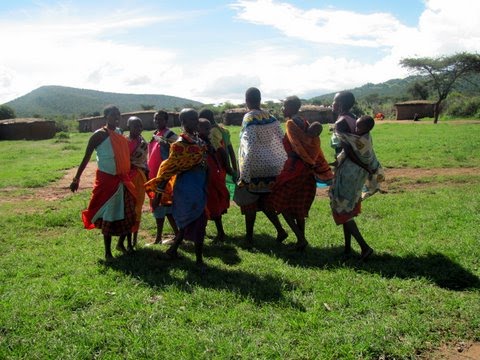
It is interesting to note that with the women’s dancing, there is much more gentleness and fluidity, so once more those preconceptions sneak in and apparently are part of every culture. The women line up and begin singing soft, sort of squeaky tunes (no one the same, I gather) and the cacophony is pretty amazing. But it’s not loud, and it all seems to come together.

And of course this is nothing special for the little ones, and if they feel like walking across the field to join their mamas, why not?

The so-called “story” of this dance is something to do with a maiden in a nearby community who has been taken (or will be taken) in marriage with one of the men of the manyatta, and the performance we see here is a welcoming ceremony of sorts to the young woman, to bring her into the community of women who already live in the manyatta. Again, it’s very fluid, as I hope you can see from the photographs in Mr. Guy’s Masai Mara (8) Album, and as the women’s dresses float in the breeze as they move, it is a lovely thing to watch.

Masai Mara (7): Maasai Dances (Men)

As we move on into the relations between the men and the women of the manyatta, perhaps this from a recent books I read will help:

“As Maasai society is polygamous, an elder can take as many wives as he can afford and father as many children as possible. Conventionally, a Maasai man of the active Ilmoran (warrior) age-set is forbidden from marrying or starting his own manyatta until the next ilmoran generation is initiative, when he and his peers – typically in their early to mid-30s – become junior elders, the group responsible for political and legislative decisions. Women, by contrast, are usually married off in their teenage years, leading to a large age discrepancy between a man and his wives.”

So I was a little misinformed when I was trying to describe the lives that Tomas and his brothers and half-brothers live. Now I understand a little better, especially since Tomas was so good about explaining what we would see when the men and women would come to “dance for you,” as he put it.

It was, needless to say, different from any other dancing I’ve ever seen and yet, it had such typical connections with the dancing we expect from men and women, especially in terms of their usual roles. For example, in this series of photographs (look in Mr. Guy’s Masai Mara (7) Album) I am taken by how athletic and energetic the men’s movement is, almost as if we were watching one of the sort of “competition” men’s dances at the New York City Ballet. It’s very rough, very raw, and full of athletic prowess.

Charles and I weren’t even asked if we wanted to don the shukas. They were just draped over us as the dance was about to begin. The music is mostly sung, although that great horn we’re holding is used later (as you’ll see) by one of the “brothers” while the others dance. 
The music is more of a rhythmic chanting, but punctuated with heavy grunts and smacking sounds, and, yes, there is a sort of story to the dance.

As Tomas tells it, the dance represents the athletic strength of the young men (well, I suppose a little older than that, if the above quoted information is correct and the men are looking to marry). The dance is shaped to demonstrate that the men are strong enough to marry up with a girl of a nearby village (not manyatta) and the idea is that the man who can jump the highest is the most eligible of young men. Not sure about all this, but that’s how it was explained to Charles and me.

Masai Mara (6): Maasai Fire w/ Sticks

One of our most intriguing findings, in visiting the Maasai and getting to know them through Tomas, is just how little they depend on things that are purchased. They do all their own medicine, as we all know, and hearing Tomas describe some of the ways they use herbs and leaves and bark and such is an amazing learning experience. And one that puts the modern Westerner a little in awe of the abilities that these people have, all crafts and skills passed down from generation to generation.

And quite naturally giving us pause when we think about how with our modern knowledge management techniques we presume we can help contribute to this particular type of knowledge sharing. I’m not so sure we can. We’re very good at capturing and sharing knowledge about what we’ve been dealing with ourselves, as a culture for some centuries. But can we capture and manage what these people know? Perhaps Prusak and Davenport are right: you can’t manage knowledge – certainly not this kind of knowledge – but you can work with knowledge, their definition of knowledge management.

As we arrived at the manyatta, even before Tomas had explained to me about the wooden stickfence, he pulled off a few leaves from a shrub and handed it to me.

“Sandpaper,” he said.

I was a little confused, but it soon became clear to me how important this particular bush is. Its leaf does indeed feel like a sheet of medium-to-fine sandpaper. As we visited the manyatta, he pointed out to me quite a few situations in which the sandpaper leaf is used to make the wood smooth, the most obvious being the beautiful wooden sticks every Maasai man uses and walks with. 
Young or old, boy or man, it doesn’t matter. No Maasai man walks along without his stick, and they are beautifully rubbed to be as smooth as they can be. 

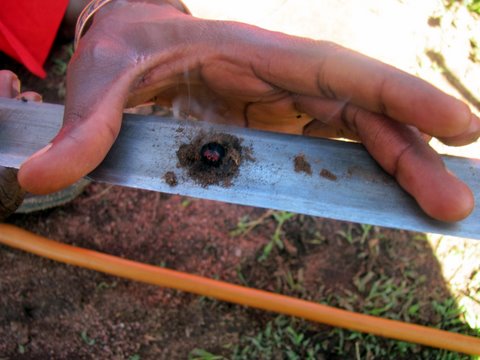
The most spectacular use of the sandpaper leaf has to be in preparing the sticks for making fire. We all heard about this when we were in the Boy Scouts, but I’m not sure any of it ever made sense, or even caught on. But these guys have it down to a fine art. They don’t bother with matches. It’s pure elbow (or hand-rubbing) grease. The trick is to gauge out a little hole in one stick, and then you trim a long smooth stick, specially chosen and carefully cut to match the hold, and the spin the long stick round and round as fast as you can, using the flat of your hands held together. It’s hard work, and often three or four or more men will be used to get it going but, as you can see in Mr. Guy’s Masai Mara (6) Album, you do soon start to smell smoke and pretty soon a little puff of smoke drifts up and then there’s more and lo and behold! There’s your little red coal which you can then use with the tender twigs to get a bigger fire going. Amazing.

Tuesday, May 4, 2010

The Western Kenya Safari (5): Farewell to Kisii and Hello to the Maasai Countryside

We woke early to begin the long journey to Nairobi, going a different route than when we came to Kisii.

For the first drive, we came via Lake Naivasha, using much the same route we had used on some of our previous safaris, to Lake Nakuru and Hell's Gate, and taking us over the mountains of the eastern side of the Great Rift Valley, from which we again enjoyed the spectacular views (with the photos previously posted back at the end of December).

For this journey, we turned left from Nakuru to cross the Great Rift Valley, which we would cross again on the way back but on a more southern route, going through the Maasai country (which I'll visit again when I have my big safari in mid-May to the Masai Mara National Park, Kenya's largest - and full of all the animals I want to see).

Our day began early, with an early-morning farewell to Charles's and Jane's house in Nyanguru Village, seen here in the morning sunlight and the cool fog that seems every morning to cover the upper reaches of the mountains (high hills?) where the villagers make their homes. Charles took the photograph, and it is a lovely view of the beautiful house that he has built for his family.

Out of Kisii, we drove along a long highway, again going up and down the mountain road and, as I've commented before, the road often left much to be desired, especially when Charles had to compete with some of the big lorries (trailer trucks) coming up or going down the mountains. The matatus as well - those amazing privately owned but public transit vans used by just about everybody when the walk would be too far - give any driver tremendous competition and there are quick a few heart-stopping moments on the country roads (especially in the mountains) as the matatus weave in and out of the traffic, with no indicators blinking, and just pulling out or cutting in as the need arises. Worse in the cities, of course, but pretty dangerous out in the countryside as well. Scary!

And while we were unable to get to Lake Victoria this trip, we did have one spectacular view of this huge body of water, which I tried to capture in one of  the PHOTOGRAPHS. After a distance, we then turned on to the highway that would take us back to Nairobi and this was a totally different travelling experience. For one thing, it's a very good highway, much safer and much better kept up than the previous highway, and since it was now mid-morning, there was not a great deal of traffic. I tried to capture some of the views of the huge flatlands of the Maasai countryside, and I'll try to get some more of this sort of view when I have my next trip there. It's all farmland, with herds of cattle everywhere, plus amazing crops under cultivation. Lots of goats and sheep, all intermingled into the same herds (which I had not thought about before - I just assumed they would be separated, as the cattle are), and long, long distances to view.