Showing posts with label Kenya - Culture. Show all posts

Saturday, November 20, 2010

Kenya: The People, The Places, The Culture (3)


Party Time

There's probably no better way to convey one's impressions of a different place than to describe how people have fun together. As it turned out, my pals and I were up for a good party back at the beginning of the month when my friend Joseph Gichuki decided to have a party for Mr. Guy.

We later learned that the party was to be an all-day affair, somehow built around the goat we were going to be eating. That idea didn't come through to me, and we arrived after the goat had been slaughtered and was being grilled. But even if we missed the beginning of the festivities we still - to no one's surprise - had ourselves a swell time.

We gathered at a place Joseph knew, and the event included a lot of just sitting around and visiting, which was very nice. No formal agenda or activities, just enjoying each other's company. New people joined us - friends of Joseph and his wife Esther - so the conversations covered just about every subject that has come up since I've been in Kenya. We spoke about politics and the new constitution, of course, and there was also lots of talk about the cultural differences between the Americans and the rest of the world - a very popular topic of conversation for international visitors these days, especially this time, just a few days after the mid-term election in the United States. My Kenyan friends - both old friends and new people I met for the first time - were intrigued with what's going on in the U.S. and conveyed to me, it seemed, some nervousness about the results of the election.

Such talk did not inhibit our good time - not with this crowd. The Tuskers were eagerly enjoyed (Tusker being the popular brand of bottled beer in Kenya), and we had many good comments (and O.K. - a few laughs) about how Mr. Guy looks in his African shirt. Made from the fabric used for the Maasai shuka, the colorful wraps worn by not only the Maasai but just about everybody else in Kenya, the shirt was a present as we started off on our excursion to the party and I was delighted. Finally I'm going to be dressed like some of the fellows I see as I roam about Kenya.

A Maasai vendor lady visited us, and while none of us was particularly interested in making any purchases, Joseph did decide that I needed a beaded Maasai wristband to go with my shirt, so instead of the guest giving the host a gift, the gesture was turned around, and I'm very grateful.

Indeed, very grateful all the way 'round to Joseph and Esther for provided such a lovely day and this happy party. It was truly a good time, and we really enjoyed ourselves. The Tuskers were delicious on a warm early-summer day, and all that good goat meat just kept coming and coming. While none of us really overate, I suppose, we did consume a lot of goat (must have been a big goat!).

And as part of the goat-eating, I experienced again something that's been happening to me recently in Kenya: the elegant respect for me because I'm older. I've long known that the Kenyans (and possibly all Africans, for all I know) have a particular code of behavior with respect to the elders of their society, but somehow it had eluded me that I'm one of that group. No one has - during my time in Kenya - made any particular comments or deference to me because of my age (well, except for with my best buddies, who do make lots of humorous comments about the wide gap between their ages and mine!), but in the last couple of weeks or so, I've noticed a little trend in this direction.

And it was made very clear at this party. I asked about it, and when Joseph and some of the other fellows explained to me why I was being treated in a special way, I was very honored. It was almost as if my age had moved me from being simply a tourist and/or a temporary employee in their country to someone (almost) matching the position of their own elders. At the party, the idea was made manifest in a couple of very sweet gestures. For example, when food was served (as it was many times during the day) it was put in front of me first, and I realized that everyone was looking at me. When I asked what was going on, it was explained to me that it was my job - as the oldest person present - to pick up my piece of goat meat and begin eating first, after which everyone else would eat.

The same thing happened as we got toward the end of the meal (not the exact end, because we had to leave early for the drive back to Nairoibi, and we didn't participate in eating the goat's head or the ritual soup that ends the meal, to come late the day). I was handed a large piece of meat, still attached to a bone and it was my job - as the oldest person - to break a hole in the bone (which I finally was able to muster, when my friends showed me how to use a beer bottle as a sort of hammer to crack to bone). The purpose of the hole? Fascinating "cycle-of-life" sequence: the bone will be thrown into the field, the grass will grow up through the hole, and the other goats will eat it through the hole, thus creating a connection between the goats that provide sustenance and the people who will be eating the goat.

The photos tell the story, so interested readers can go to Gichuki Party 06 Nov 2010 to get the full description of this particular day in Mr. Guy's life in Kenya.

Sunday, May 23, 2010

Masai Mara (8): Maasai Dances (Women)

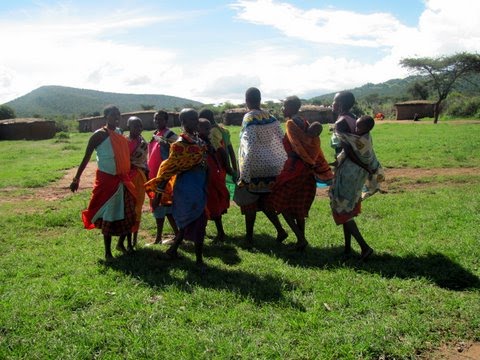
It is interesting to note that with the women’s dancing, there is much more gentleness and fluidity, so once more those preconceptions sneak in and apparently are part of every culture. The women line up and begin singing soft, sort of squeaky tunes (no one the same, I gather) and the cacophony is pretty amazing. But it’s not loud, and it all seems to come together.

And of course this is nothing special for the little ones, and if they feel like walking across the field to join their mamas, why not?

The so-called “story” of this dance is something to do with a maiden in a nearby community who has been taken (or will be taken) in marriage with one of the men of the manyatta, and the performance we see here is a welcoming ceremony of sorts to the young woman, to bring her into the community of women who already live in the manyatta. Again, it’s very fluid, as I hope you can see from the photographs in Mr. Guy’s Masai Mara (8) Album, and as the women’s dresses float in the breeze as they move, it is a lovely thing to watch.

Masai Mara (7): Maasai Dances (Men)

As we move on into the relations between the men and the women of the manyatta, perhaps this from a recent books I read will help:

“As Maasai society is polygamous, an elder can take as many wives as he can afford and father as many children as possible. Conventionally, a Maasai man of the active Ilmoran (warrior) age-set is forbidden from marrying or starting his own manyatta until the next ilmoran generation is initiative, when he and his peers – typically in their early to mid-30s – become junior elders, the group responsible for political and legislative decisions. Women, by contrast, are usually married off in their teenage years, leading to a large age discrepancy between a man and his wives.”

So I was a little misinformed when I was trying to describe the lives that Tomas and his brothers and half-brothers live. Now I understand a little better, especially since Tomas was so good about explaining what we would see when the men and women would come to “dance for you,” as he put it.

It was, needless to say, different from any other dancing I’ve ever seen and yet, it had such typical connections with the dancing we expect from men and women, especially in terms of their usual roles. For example, in this series of photographs (look in Mr. Guy’s Masai Mara (7) Album) I am taken by how athletic and energetic the men’s movement is, almost as if we were watching one of the sort of “competition” men’s dances at the New York City Ballet. It’s very rough, very raw, and full of athletic prowess.

Charles and I weren’t even asked if we wanted to don the shukas. They were just draped over us as the dance was about to begin. The music is mostly sung, although that great horn we’re holding is used later (as you’ll see) by one of the “brothers” while the others dance. 
The music is more of a rhythmic chanting, but punctuated with heavy grunts and smacking sounds, and, yes, there is a sort of story to the dance.

As Tomas tells it, the dance represents the athletic strength of the young men (well, I suppose a little older than that, if the above quoted information is correct and the men are looking to marry). The dance is shaped to demonstrate that the men are strong enough to marry up with a girl of a nearby village (not manyatta) and the idea is that the man who can jump the highest is the most eligible of young men. Not sure about all this, but that’s how it was explained to Charles and me.

Masai Mara (6): Maasai Fire w/ Sticks

One of our most intriguing findings, in visiting the Maasai and getting to know them through Tomas, is just how little they depend on things that are purchased. They do all their own medicine, as we all know, and hearing Tomas describe some of the ways they use herbs and leaves and bark and such is an amazing learning experience. And one that puts the modern Westerner a little in awe of the abilities that these people have, all crafts and skills passed down from generation to generation.

And quite naturally giving us pause when we think about how with our modern knowledge management techniques we presume we can help contribute to this particular type of knowledge sharing. I’m not so sure we can. We’re very good at capturing and sharing knowledge about what we’ve been dealing with ourselves, as a culture for some centuries. But can we capture and manage what these people know? Perhaps Prusak and Davenport are right: you can’t manage knowledge – certainly not this kind of knowledge – but you can work with knowledge, their definition of knowledge management.

As we arrived at the manyatta, even before Tomas had explained to me about the wooden stickfence, he pulled off a few leaves from a shrub and handed it to me.

“Sandpaper,” he said.

I was a little confused, but it soon became clear to me how important this particular bush is. Its leaf does indeed feel like a sheet of medium-to-fine sandpaper. As we visited the manyatta, he pointed out to me quite a few situations in which the sandpaper leaf is used to make the wood smooth, the most obvious being the beautiful wooden sticks every Maasai man uses and walks with. 
Young or old, boy or man, it doesn’t matter. No Maasai man walks along without his stick, and they are beautifully rubbed to be as smooth as they can be. 

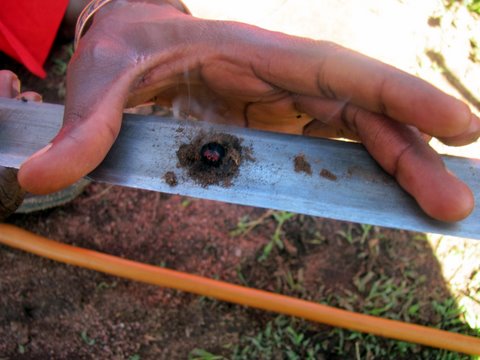
The most spectacular use of the sandpaper leaf has to be in preparing the sticks for making fire. We all heard about this when we were in the Boy Scouts, but I’m not sure any of it ever made sense, or even caught on. But these guys have it down to a fine art. They don’t bother with matches. It’s pure elbow (or hand-rubbing) grease. The trick is to gauge out a little hole in one stick, and then you trim a long smooth stick, specially chosen and carefully cut to match the hold, and the spin the long stick round and round as fast as you can, using the flat of your hands held together. It’s hard work, and often three or four or more men will be used to get it going but, as you can see in Mr. Guy’s Masai Mara (6) Album, you do soon start to smell smoke and pretty soon a little puff of smoke drifts up and then there’s more and lo and behold! There’s your little red coal which you can then use with the tender twigs to get a bigger fire going. Amazing.

Masai Mara (5): Maasai Manyatta

We had seen many of these family compounds, known in Maasai as a manyatta, as we drove around the Maasai countryside, both on this safari and when we had returned from Kisii some weeks back. They are not villages, as such. Instead they are compounds where the extended family of one man lives. Let me try to explain (I’m not sure I can).

The whole situation centers on the man, and I have been led to believe the situation Tomas shared with us (when I described it to others) is fairly typical. His manyatta, which we see here from a distance, is a compound of houses created by his grandfather, for his six wives and their children. Tomas is one of the children of one of the grandfather’s sons, and his father lives in the compound with his three wives and their children. Each wife has her own dwelling (which the women build, using heavy sticks and cow dung but unlike the houses we saw in Nyanguru Village in Kisii, these houses are not covered over with dried mud, to provide a baked-on plaster-type of finish). As you can see in the photographs in Mr. Guy’s Masai Mara (5) Album, these houses are pretty raw. The structure of the manyatta is circular, with an outside fence made up of sticks and branches and dried leaves, about six or seven feet in height, and it is there to keep the lions away from the cows (we were told). There is one narrow entrance – about three feet wide – and it is covered by a separate gathering of branches and twigs, put in place when the people of the family retire for the night.

The cows? Yes, they are driven home each night, from wherever it is they are grazing, and they come to the center of the manyatta. In some manyattas, there is also an enclosed circular space in the center for the cows, but in Tomas’s manyatta, there is no enclosure. The cows are just brought in and wander about in the space inside the circle of the fence and the dwellings.

Many children were about and, as usual, I was fascinated by them, but unlike other African children I have met, these had nothing to do with Charles and me (although they kept an eye on us all the time! – they weren’t quite sure what we were up to). We weren’t invited to speak with them, or pay much attention to them, and it seemed to me that they liked it that way.

Although I felt a little as if doing so would invade the families’ privacy, Tomas kept inviting me to take pictures, assuring me that we were welcome to take as many photographs as we liked. And with all the colors of the shukas and the other beautiful garments the people were wearing, it was a wonderful photo opportunity, and I had a good time. And learned a lot, and now I know, for example, why most shukas are bright red, or some version of it. Wildlife are uncomfortable with the color red (associating it with fire, perhaps?) and one wears red in the forest to keep the animals away. It was a fact we discovered ourselves one morning, when we unexpectedly found ourselves nearing a herd of elephants. Tomas and I, standing in the van with the top open in the cool morning air, had wrapped ourselves in shukas and as we got even not very close, the elephants started moving away. Tomas surmised it wasn’t the van – which elephants see all the time – but the bright red fabric we were wrapped in. Could be.

As for the residents of the manyatta, I had a hard time getting my arms around all the relations, but apparently Tomas and his brothers whom we met and interacted with – a little too old to live in their parents’ house as they have already been through their initiation and “warrior” period (which I’ll try to explain later) – are among 26 siblings of their father and three different mothers. All told, some 120+ people live in the manyatta, all descended from (or connected with, I suppose) Tomas’s grandfather.

As for family life, here’s the picture I get: the men concentrate on hunting. 
They use only spears and knives, and in the course of our time together, Tomas invited us to go on a nature walk. When asked what our protection would be, should we come across any wildlife, he assured us that his spear and his knife would be all that was needed, and he was quite proud of the fact that he had had his four years in the bush, and he would be able to protect us. Charles and I declined the nature walk, with great respect.

So the men concentrate on hunting and tending the cows (the Maasai don’t say “cattle” when they speak English), sometimes going far away during certain seasons of the year. The boys tend the cows (and goats and sheep) closer to home and, as I’ve noted, drive the cows home every evening, to be enclosed within the manyatta.

The open field in the center of the manyatta is used for the young men’s initiation rite, in which the grandfather supervises their circumcision in the open area (I presume it is at a time when the cows are not there). There is an important stake in the ground where the grandfather stands, and all the ceremonies take place in front of him, with all the residents of the manyatta present. The boys are then given their spear and knife and sent to the bush, where they live for four years, learning how to take care of themselves and each other (they usually go in small groups, sometimes as few as two, but never alone).

It was after telling us this that Tomas invited us to enter the house. I was a little frightened, not the least because I had to cross over the wet muddy field where the cows come in each night and I had the distinct impression that what I was walking through was not just mud (and in fact as you can see in one photograph, Tomas extended his hand to help me when we left the house, as it is very easy for a muzungu to slip and fall in the much, apparently happening often!).

Inside the house, it was pitch black (we used the flash – at Tomas’s suggestion – to take the pictures) but we inched our way through, into a small room, probably six feet by six feet. This was the main room, with cooking apparatus and a hard wooden bench on which I was invited to sit, as it was the seat of honor. This seat of honor is also the bed for the parents. In a tiny room off to the side was where the children sleep, and in an even smaller tiny room, a long enclosure for the “baby cows” (the Maasai don’t say “calves”). Altogether, eleven people sleep in this tiny space.

As I said, Tomas and his adult brothers (some shown here, and many in the outdoor photos) live elsewhere, but I was never told where. They are all looking to marry, but they must each collect a dowry of at least ten cows plus another ten to indicate their developing wealth and since Tomas – in his mid twenties – doesn’t yet have these resources, he and his brothers in the same situation must wait.

And on the other delicate subject that was raised, quite openly and not by me or Charles? Impregnating a girlfriend isn’t really a problem because she has the baby and when she is married the baby comes along as part of her family. Say, what? This was a little hard to deal with, coming up as spontaneously as it did, but I got the picture.

As we prepared to leave the house, Tomas proudly found the lion head he wears for ceremonial occasions. He killed the lion when he was a warrior (I don’t think that is quite the right word but it’s what the Maasai use to describe the young men living in the bush), and it, along with his initiation ceremony, is proof of his manhood. He and all his brothers have – or aspire to – the status of manhood to define them as they move into their lives as adults.