Wednesday, October 15, 2014

Personal History: Knowing Ralph Walker


"One of the few living people who knew Walker personally."

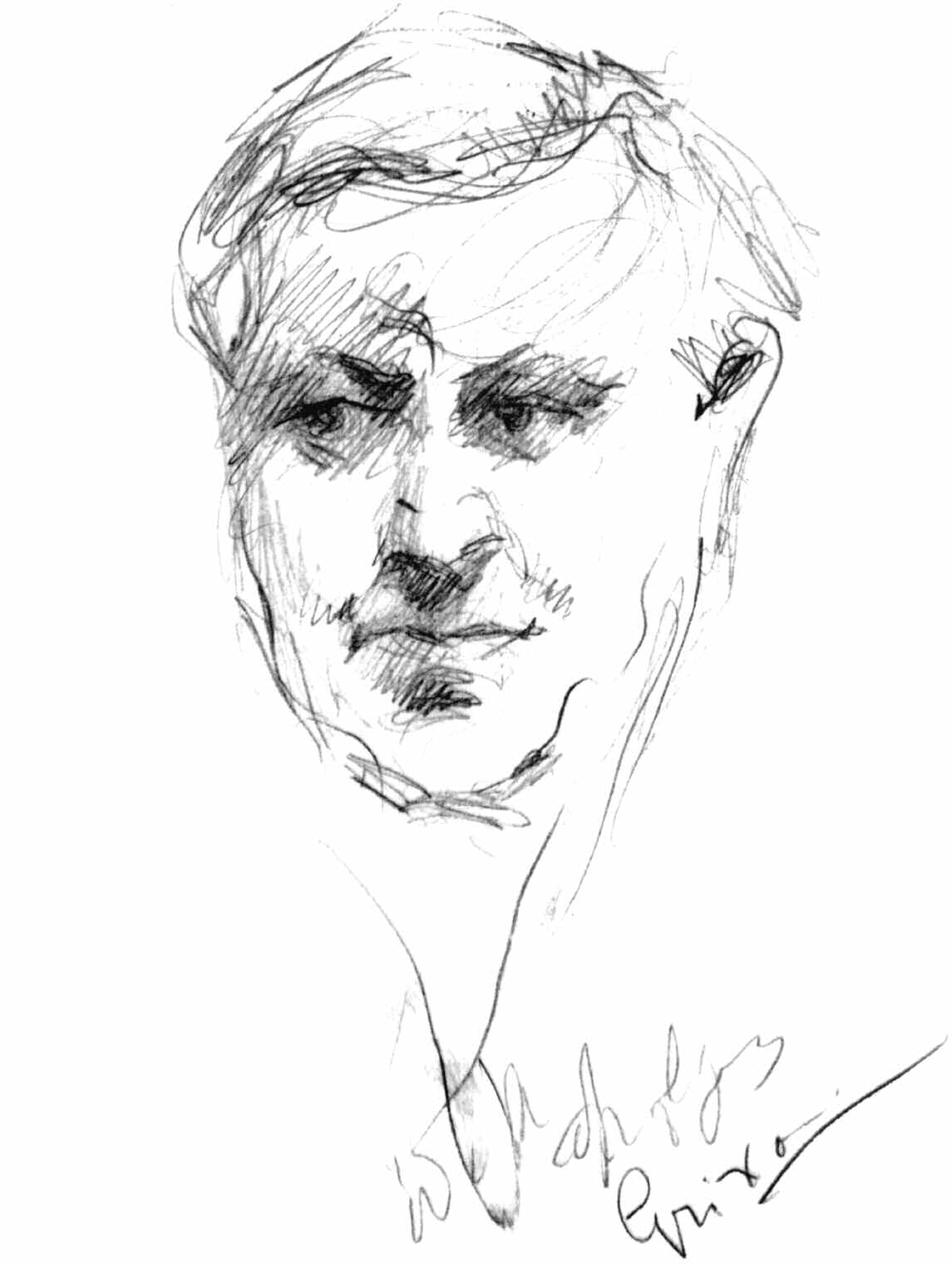
I was greatly honored to be included in the recent documentary about American architect Ralph Walker (1889-1973), and, yes, the sentence above was used to introduce me (the film can be viewed online here).

Ralph Walker
sketch from
architectsandartisans.com
Sort of a new way of thinking about myself, I suppose. While I won't comment too much about the "time distance" between then and now, I was indeed very fortunate to have met Ralph when I was a young man. For some reason, when I first came to New York, Ralph took a great interest in the young man from Virginia, and for the next six years he and I had a very special friendship. He introduced me to many people he knew, and seemed to delight in having me - and my sometimes girlfriend in those days - come to Walkerburn - his beautiful home in Chappaqua - for week-end visits. With his housekeeper and cook Louise we had many good times (and shared wonderful meals) and had long, long conversations about ever so many things. He was a widower (his wife had died a couple of years before I met him), and he and Louise seemed to take a special interest in me (or us) as their guests.

And in New York itself - on his several-times-a-week days in the city - Ralph took on the very easy task of speaking with me about art, architecture, music, the theatre, New York's history, the Murray Hill neighborhood (where I lived - and still live), and the myriad other subjects in which we both shared interest. And it was an easy task, too, for I had never met anyone quite as knowledgeable about so many subjects as Ralph was. I was a very receptive audience and although he spoke often about how much he took from me - about young people, "modern life" (he loved to say that), and similar topics that emphasized our differences, now as I remember our friendship I'm convinced that I was the real beneficiary of this interaction between two people from such different times (we were 51 years apart in age I later figured out).

We also did a lot of things together, since he was an avid opera fan and enjoyed the theatre, as I mentioned in the documentary. He was an avid museum goer, and I certainly couldn't resist when he asked me to come along to one of the city's great museums (he specially loved the Metropolitan Museum of Art, not surprisingly since the "gentleman's office" he designed for one of his buildings was once displayed there in an exhibition of contemporary office design). And I have a memory of being told that he designed the Grace Rogers Rainey Auditorium at the Metropolitan Museum, but I can't find the reference at the moment, and I'm not sure he spoke about it or if it's just something I remember).

But saying that seems to imply Ralph would have wanted to go to the Met from self-interest which, from my experience, would have been just about as far as we could get in describing Ralph's personality. He was not that way at all.

But he did have opinions, many of which are discussed in the documentary and in the writings about Ralph and his work and what he thought about other people's work.

The story of how I got involved in the documentary is perhaps of interest, at least from my point of view, because it's one more example of those serendipitous things that seem to happen as we go through life. For some reason, I heard that one of Ralph's buildings (the West 18th St. Telephone Building, now called Walker Tower) was to be re-purposed into residency apartments - makes sense, doesn't it, now that communication technologies have changed so drastically since the building was built in 1931? - and that an exhibition about Ralph's work was installed in the lobby of the ground floor of the building. So Andrew and I made an appointment (required) and went to see what we could see.

Walker Tower
We were thrilled. Even, perhaps, mesmerized (might be a better word for what we experienced) as we took in the very well-designed and well-installed items that made up the exhibition. Andrew is an amateur architecture historian specializing in American and, especially, New York architecture, so there I was - in the first exhibition ever about the work of someone I knew so well early in my life, and I had my own private expert to show me around.

We also had a very knowledgeable guide - whose name I've since lost - who give us a very informative background and introductory talk and then just turned us loose to walk around through the exhibit. We had a grand time and spent - I would guess - more time with the exhibit than any other visitors who came to see it. And as there was no one else there when we were, we just took our time.

The exhibition was called "Ralph Walker: Architect of the Century" and had been curated by Kathryn E. Holiday of the School of Architecture, University of Texas, Arlington (she also wrote the beautiful limited-edition catalog - published by Rizzoli in 2012 - which itself is turning out to be a valuable reference for studying Ralph's work).

We reluctantly finished our time with the exhibit, and as we were preparing to leave, the guide commented that although she hadn't been eavesdropping she did notice that I seemed to know a lot about Ralph and his work. I went into my "I'll-be-modest" routine but Andrew encouraged me to tell her more about knowing him when I was a young man.

So I jumped in and had a fine time talking about how I knew Ralph in the late 1960s and early 1970s, and it was from that conversation (I assume) that my name got to the producers at WNET's "Treasures of New York" series. When they decided to put together the documentary, I was contacted and spent a delightful afternoon speaking about Ralph with one of the WNET Executive Producers at my home. That led to a call from the show's producer who indicated that the program needed someone who knew Ralph personally (I think they had plenty of academic and technical and architectural experts) and we were on our way.

Great fun, and as I've thought more about Ralph and his life and knowing him, I'm hoping to continue this commentary with some of Guy's thoughts about his writings, some of his philosophy and experiences that he shared with me (he was a marvelous story teller). Stay tuned.

Sunday, September 28, 2014

A Terrific Book for Elephant Lovers


And you know who you are.

Yes, we're the folks whose ears perk up when someone says, "Have you heard about this elephant...?"

Since I had my time in Kenya - and got to know the elephants there pretty well - I've enjoyed writing about my experiences and sharing photos and commentary from time to time.

Recently, on the recommendation of another member of the "thinking-about-elephants-a-lot" gang, I had the delicious opportunity to explore The Elephant Whisperer: My Life with the Herd in the African Wild by Lawrence Anthony.

It's a beautiful story, about a man whose life was built around animal conservation and who, when asked to take care of a herd of rogue wild elephants that had been causing problems at another private game reserve, he couldn't say "no." His Thula Thula game reserve in Zululand didn't have any elephants - they had left that part of Africa about a century ago - and even though he knew it would be a challenge to work with these troublesome wide animals, he took them on.

He worked very carefully to get to know the animals, and - more important - to have them get to know him. And trust him. He was eventually able to create a very special relationship with the animals - not all of them, as some of them (one in particular) had been badly damaged in previous interactions with humans. Nevertheless, the story Anthony tells - with co-author Graham Spence - is a story worth telling. There's humor, sensitivity, and, yes, a couple of "bonding" situations that remind me of my experience in the Kenya in Summer 2013, which you probably read about (if you didn't it's here).

Much is made in the book of the sensitivity of the elephants and their ability to understand things that we human beings don't usually expect animals to understand.

And one example of the elephants' sensitivity is the fact that they are known to mourn, so one of the interesting stories about Anthony's work and his death has to do with the animals coming to mourn him when he died. There are a number of versions of the story, and I happen to like the one told at a site called "The Delight Makers" (no, I had not heard of it either).

The story - Wild Elephants Gather Inexplicably, Mourn Death of "Elephant Whisperer - is sweetly told and gives a good picture of how animals deal with some of the same situations we humans are confronted with. I loved reading this description (just as I loved reading the book - in reading it and not knowing that Anthony had died just a couple of years ago, I felt a wonderful closeness to this fine man). I didn't so much love the advocacy message of the text of the film - but why would I, as I know nothing about the organization? - but the photography is splendid and made me anxious to head back to Kenya to visit my elephants.

So I recommend the book. It moves fast, and you get the feeling you're getting to know Lawrence Anthony well as you read the book. As well as the many interesting people with whom he is called upon to deal with (both positively and - ahem - some with some difficulty) during the course of the story. If you like reading about elephants. you're going to love this one.

Tuesday, August 26, 2014

The New York Summer Winds Down with a Special Happy Memory


Caramoor's Italian Pavilion,
overlooking the Butterfly Garden
Yes, the Metropolitan Opera and the unions seem to have settled the labor dispute, and we've been told that we'll have opera in New York again this autumn. And there's the usual array (the only word for it) of up-coming non-operatic events: the New York City Ballet, fantastic theatre offerings - or so the advance publicity tells us - and lots more. I personally am looking forward so some of the great choral works to be presented, the programs of the Chamber Music Society and, of course, the New York Philharmonic. But there's so much more. It's really tough being a music-loving New Yorker.

Summer was easy. Plenty of offerings but, well, it seems to be easier to choose in the summer. So our gang focused on one event, and from my point of view, it outdid just about anything I've experienced in a long time.

I'm talking about the Caramoor Summer Music Festival, this year celebrating its 69th Season with all kinds of good stuff, and we were able to go with friends to the first (of what we hope will be many) Caramoor Opera "Week-Ends." It was the week-end of July 18-20, and it was special. Opera is often on the schedule at Caramoor, but this was the first time a "package" was offered, and it was a delightful experience.

Caramoor is a beautiful estate located near Bedford NY, about forty miles north of Manhattan (actually the town is Katonah NY, but I think of it as Bedford - don't know why - probably because friends live there).

Will Crutchfield, Caramoor's
Director of Opera
It was a full week-end, highlighted needless to say by the opera performances. The choices couldn't have been better, or better "teaching" operas for those of us who love the medium. Will Crutchfield (pictured left), who directs the opera program at Caramoor, had chosen two operas with Victor Hugo "connections," you might say. Donizetti's "Lucrezia Borgia" was performed on Friday and Verdi's "Rigoletto" on Saturday. They are both champion bel canto vehicles and Crutchfield brought together the champions to bring it off.

Led by the Met's Angela Meade, already at her young age an accomplished bel canto specialist (and favorite), the entire ensemble brought Donizetti's dangerously challenging music to great success. Indeed, Meade and the company even provided an special encore, following the opera with a re-insertion of the aria and chorus “Era desso il figlio mio,” an incredibly "explosion of vocal fireworks" (as New York Times critic Corinna da Fonseca-Wollheim described the encore in her review). Donizetti had cut the piece from the "Lucrezia Borgia" when he revised the opera seven years after the its premiere, which I have to guess had something to do with the demands on the performers. That did not stop the Caramoor folks, and - truth to tell - the piece was performed so spectacularly we were all left in a state of shock, disbelief, and, of course, sheer delight. This is what music is all about, isn't it?

And, yes, the next night was equally accomplished. We've all come to know and love "Rigoletto" so much that - for some opera goers - it is difficult to get excited about another performance of this grand old war horse (as some people describe "Rigoletto" - uninformed people, in my opinion). Yet with the combination of the right cast, the highest performance standards, and the right "mood" (to say nothing of the grand surroundings of a place like Caramoor), a performance like the one we heard can make it all come together with great success.

That's exactly what happened on Saturday night, and by using the complementary elements of both Victor Hugo's Lucrèce Borgia and his Le roi s'amuse, Crutchfield and crew were able to ring down the curtain on an amazing week-end of what can only be referred to as "high-end" bel canto music.

Spanish Courtyard of the Rosen House,
site of the lectures and recitals
And there was more. Saturday was chock full of pre-opera events, including a swell informative conversation between Crutchfield and his daughter Victoria (herself a recognized stage director of opera, theater, and - as she puts it - "everything in between"). The topic was "What Verdi Learned from Donizetti," and it was full of more of those "connections" I referred to earlier. Then there was a recital by Caramoor's Bel Canto Young Artists of various composers' setting of Hugo's poetry, followed by a staged reading of scenes from Hugo's Le roi s'amuse, and another recital, this one of trios for female voices by Caramoor's Bel Canto Artists and Apprentice Artists. Finally, before the "Rigoletto" performance, there was an "introduction" to the opera from Ken Benson, an artists manager with 25 years as Vice-President of Columbia Artists Management, following which we all trooped off to the splendid singing I described above.

What a week-end for us opera lovers! Good friends, good food, good music. What more could we ask?

Sunday, June 8, 2014

Dateline Vancouver: British Columbia's Museum of Anthropology


Thursday was our day to visit the splendid Museum of Anthropology and we had ourselves a wonderful visit. As anyone who has been to Vancouver knows, this is one of North America's most beautiful cities, and we are definitely enjoying the harbor area (where our hotel is located) and watching the great cruise ships come in and out. We had discovered the ease of moving about in that part of the city, so the idea of riding out to the campus of the University of British Columbia, where the museum is situated, was anticipated with pleasure.  


Museum of Anthropology
University of British Columbia
So off we went - with friends Dale and Debi Stanley - to visit the museum. Andrew and I knew nothing about it, and even less about the history and artifacts of the Pacific Northwest peoples. We had of course (being New Yorkers) seen the very fine exhibitions at the American Museum of Natural History but for some reason neither of us had ever paid much particular attention to what was on display there. That won't be the case in the future. We had no idea what to expect when we visited the Museum of Anthropology, and were we ever surprised! Both of us, and Dale and Debi too, were a little overwhelmed by the quality of the exhibitions and the stunningly beautiful setting at the Museum of Anthropology.


Another view, with house posts
and reconstructed houses
In my opinion - and I said so when I wrote to several friends from Vancouver - UBC's Museum of Anthropology has to be one of the best museums I've ever visited. For one thing, since I knew so little about the First Nations peoples of the Pacific Northwest First Nations, I came away with a wealth of new knowledge about this fantastic history, and I'm sure I'll be reading about this subject for a long time. And when I visited the MOA (we arrived in time to join a guided tour, with a very knowledgeable docent) I had my eyes opened to beautiful carved wooden structures that I don't think I ever knew existed (or at least paid much attention to). I learned about how the canoes are made, about the different meanings of so many of the carvings on the totem poles (and which were used as house posts, with several different purposes), the carved boxes from a single block of wood. All absolutely fascinating. 

As noted in the university's catalogues, the museum is affiliated with the UBC Department of Anthropology and it is world-renowned for its collections, research, teaching, public programs, and community connections. We were most impressed with the impressive First Nations of British Columbia collection, but that is not to say we weren't equally impressed with the many other artifacts on display - through a partnership between the museum and the Laboratory of Archaeology in the joint Canadian Foundation for Innovation (CFI).


Of special interest at the museum is a sort of "centerpiece" work, sculpture commissioned by the museum and displayed in a special glass-roofed rotunda (hence the not-so-good quality of the photograph). Bill Reid was an amazing Haida artist, and this work - The Raven and the First Men - is a fabulous depiction of the Haida myth of the Raven discovering mankind in a giant clamshell. Carved from a laminated block of yellow cedar, the spectacular wooden piece catches the viewer's attention and frankly, for me, I found I was having great difficulty pulling myself away. A large collection of other Bill Reid works are on display at MOA, including lovely studies and other versions of this splendid work. Truly amazing to see. 

At MOA, there is an amazing, vast collection of study materials on display - in glass cases, sliding drawers, and huge cabinets, and all accessible (at least in the public areas) to visitors in the MOA Centre for Cultural Research and the Multiversity Galleries, with more than 10,000 objects from around the world. And for those of us specially interested in knowledge development and knowledge sharing (and in this case in knowledge utilization as well, in the development and sharing of this content for teaching and scholarship), we found the MOACAT digital catalog system - available throughout the galleries - a splendid demonstration of the MOA's focus on combining the museum experience with current scholarship. Well done. 

Random photos (not yet captioned) of our visit to the Museum of Anthropology at the University of British Columbia can be seen here.


Friday, May 30, 2014

New York's Opera Season Ends (I)


Metropolitan Opera, Lincoln Center
We New Yorkers are fortunate to have opera year-round,
as some of the smaller opera companies - upon which we are going to depend more and more - perform during the June-September months.

For the most part, though, we tend to attach our opera "season" to the dates of our great Metropolitan Opera Association, usually from the last week of September through early May, and now that's over. Just three weeks ago I attended the final performance of the season, Bellini's grand old showcase "I Puritani" - a splendid performance bringing back very happy memories (more about that later).

I was impressed with Anthony Tommasini's comments on the season, published in The New York Times. On May 13, he wrote in A Look Back at the Year of Top Voices that - with all the worry about next season's performances - we've had a very good year, topped by the return of James Levine (for which we are all extremely grateful) and Peter Gelb's "fresh theatrical thinking" about presenting works for the Met's audience.

And in this essay Mr. Tommasini's focus on the season was on the singing, a point of view with which I couldn't be more in agreement: "...one takeaway from the season is that, as always, singing comes first in this art form."

So I'm thinking about what we experienced with our Monday series (and some specifically chosen additions). Coming with our pleasures at the opera house were several HDLive performances (which I note the Met has now started to refer to "movie theater transmissions" - sort of a silly description - it seems to me - but I guess their marketing people know what they're doing). By some people's standards, I suppose that's a pretty full plate of opera but since this is one of the major reasons - well, for some of us - for living in New York we're happy to have it, good singing and all.

And there used to be more. The season began with the sad news that our beloved New York City Opera was entering into bankruptcy and would close, after 70 years for performances. Mayor LaGuardia's famous "people's opera" succumbed to a lot of problems but from what most of us have figured out, it was simply bad management over the past ten or twelve years. We were so disappointed to have this news (at our house we had subscribed to NYCO as well) but the company simply couldn't be saved. I hope someone someday will write a full history of this wonderful company. It meant so much to so many of us. [And until then, we have Fred Cohn's very fair description of the sad story, "The Ballad of NYCO" published in Opera News in January 2012 and two months later Alex Ross's brief commentary remarking on NYCO and the dispiriting New York opera scene in The New Yorker, March 12, 2012.]

And we did have the opportunity for a wonderful send-off, right at New York City Center, where the New York City Opera had first performed. Put on by the musician's union (one of the very unions leading - as Tommasini describes with respect to the Met - "critical labor negotiations that have turned acrimonious"), it was a night to remember. Lots of good singers, wonderful orchestral playing, and a sweet ending when during the curtain calls Plácido Domingo - who started at New York City Opera - kissed his hand and leaned down to plant his kiss on the floor of the stage. A bittersweet evening indeed.

That's enough for now. More about this season's opera experiences below.


Sunday, May 25, 2014

New York's Opera Season Ends (II)


Back to the Met: I'll let Mr. Tommasini describe the singing (splendid - no disagreement there!). I'll share my thoughts about several wonderful highlights, including Nico Muhly's "Two Boys," a fresh and very modern spooky story set to a lovely score. Muhly writes in a wide-variety of "styles" and I'm especially taken with his choral music. Very important work (coming to New York - with slight revisions - from a 2011 premiere at the English National Opera) and I'm pleased we had it here.

We had three Strauss jewels, and since I'm a major Straussian I was very happy. I had missed my Strauss when his works were excluded to make room for the 200th-anniversary Verdi and Wagner performances (and truth to tell, the new Wagner "Ring" in the 2011 and 2012 seasons sort of got the lion's share of the attention - 'way too much for what we had in the cycle itself). But we made up for it this year, with the splendid and almost overwhelmingly beautiful "Die Frau Ohne Schatten" in the autumn. This has to be one of the most beautiful operas ever written, and this thirteen-year-old Herbert Wernicke production - not seen for ten years - must be one of the loveliest to look at of all the productions done for this opera. So well performed, and if the season had had a single highlight, this would have been it.

And we also had the last performances of "Der Rosenkavalier" - the beautiful but, yes, worn-out Robert O'Hearn production of 1969. A great, great lavishly visual production, but it was time to go and - quite coincidentally - we were there for the last performance. Of course I loved every minute of it, and since it was the first of many productions of this great opera I ever saw, I will miss it, but I will do without this production. And it will be great fun to see what the new production - when it comes - looks like. I'm wondering if any other production at the Met has lasted 45 seasons and still looked this good.

Our final Strauss was the gorgeous "Arabella," sung so well at the house just last month. Another well-done and long-lasting production (by Otto Schenk in 1983), the show looks good. I felt the cast was very good, although there were some commenting on these performance who would not rank the singing with Tommasini's singing highlights of the season. I didn't feel that way, and I thoroughly enjoyed the evening.

What else? Two very special new productions, in addition to "Two Boys," made us sit up and take notice. Like the Las Vegas rat-pack "Rigoletto" of last season, the new "Falstaff" blew us away. Replacing Franco Zeffirelli's 1964 production (yes, even older than that "Der Rosenkavalier" I referred to above!), this was set in post-WWII England and - as much as we resisted - it worked, with splendid singing and, well, just an overall fun and musically satisfying evening. The new "Werther" also pleased, and once again all of us were impressed with the overall ensemble work done at the Met.

And the happiest opera experiences, it seems, came at the end of the season. We had a great time with "La Cenerentola" and even though it wasn't a happy-ending opera like "Cenerentola," the last night performance for the season was "I Puritani," another one of the greats. And clever scheduling, on the part of the Met (although I'm joking - I'm sure it was only coincidental) the last day of performances was "standing-ovation" day at the opera house.

The afternoon performance was "La Cenerentola" and it proved - from the first performance in April - to be the popular hit of the season. We were at the first performance, with Javier Camarena singing the prince for an ailing Juan Diego Florez. Camarena was spectacular, and the ovation went on so long we thought we would have an encore (that happened in future performances). For the last matinee, Florez had come back to the performances, so that afternoon seemed to generate some excitement that carried over into the evening.

As I said, the last performance of the season was "I Puritani" and this time the spectacular tenor was Lawrence Brownlee in a performance that had us all on the edge of our seats with excitement. No encore this time, but his singing definitely ranked with that of Camarena and Florez in "La Cenerentola," giving lots of talk in New York about a new version of "the three tenors." Silliness aside, they were all just terrific as we ended the season. I think Mr. Guy gives a little bit of edge to Brownlee.

And what memories that old 1976 production brought back. Starring Joan Sutherland, Luciano Pavarotti, Sherrill Milnes, and James Morris, it was one of the highlights of my opera-going younger days. And when brought back ten years later to celebrate Joan's 25th anniversary at the Met, it was still a delicious experience to hear. No matter that the production is not one of the Met's best productions, it works (and it worked then) and whenever I hear this splendid opera I can't help but remember the glorious singing of Dame Joan. Ah, she is missed.

So we move on. I love to hear older opera lovers talk about the "golden age" of opera (it's always the time when they were nearing middle age and were hearing that generation's best singers), and I love to think about how what we hear is different for all of us. I'm not threatened by the Met's sharing house performances with audiences in "movie theater transmissions," and, yes, for me and most of my generation, we prefer the opera house. But whatever the situation is, for viewing and hearing the opera, I think we're pretty lucky, as this past season proved. And for those of us living in New York, I continue to be amazed - and appreciate - what is done for us at our great opera house here in New York. We're very lucky.


Sunday, May 18, 2014

Spring Visit: Canterbury Windows in New York


View from The Cloisters
across the Hudson River
Up in Fort Tryon Park, in northern Manhattan, we have a very special place that appeals to so many of us New Yorkers. It's The Cloisters museum and gardens and it has just completed the celebration of its 75th anniversary.

And it's been a splendid celebration, complete with a beautifully written and produced issue of The Metropolitan Museum of Art Bulletin devoted exclusively to the history of the Cloisters. "Creating The Cloisters" by Timothy B. Hubbard provides a wonderfully detailed description of this branch of The Metropolitan Museum of Art specially devoted to the art and architecture of medieval Europe. The collection was assembled from architectural elements, both domestic and religious, largely dating from the twelfth through the fifteenth centuries.

Not surprisingly, the collection is full of many artifacts that each evoke a particular response from visitors (and it doesn't matter whether you are a believer or not - this is great stuff to look at and think about). I have a couple of favorites, but I'm not a scholar. So I've never taken the time to study the official guidebook or delve deeply to find out more about them (should do that one day). I just like them.

Wise old people
The first is what I like to think of as a group of kings or prophets or something like that, but who knows? Perhaps they are just wise old people (I started to write "wise old men" but I don't think the figure second from the right would be very happy about that!). I'm specially taken with the last figure on the right, as he seems to be pondering some special problem that is going to be very important to everyone who knows him once he solves it (and don't you sometimes sit with your cheek against your right fist while you trying to solve a problem?).

Two ladies
Then there are the two ladies topping off a column and providing substance to its capital. Just what is the lady who in not front-and-center thinking about? Could it be something along the lines of "Just who does she think she is, getting out front and getting all the attention when I'm the one people should be looking at?" I love that stone carvers in olden times could incorporate their own sense of humor in their work.

Now, with the 75th Anniversary celebrations ended and life for visitors to The Cloisters back to normal, we've just had another special treat. [And when I say "back to normal" I'm simply referring to life as "normal" as it can be for visitors - New Yorkers and out-of-towners alike - who thrive on learning all they can about New York's history and how it attached to special interests like those of John D. Rockefeller Jr. - who built The Cloisters - and George Grey Barnard, the person who brought together the original items that became the first collection at The Cloisters.]

Jared (left) and Phalec (right)
The special treat I'm referring to is this: In a special arrangement with Canterbury Cathedral, we've just had a wonderful opportunity to view six Romanesque-period stained glass windows that have never been away from the cathedral grounds since they were created in the 1178-1180 period. At Canterbury, the stonework surrounding the windows is being restored, and while the restoration work is being done, the windows have been on loan to us.

The exhibition was called Radiant Light: Stained Glass from Canterbury Cathedral at The Cloisters and there's this from a nice published description at the museum site:

Thara
"The windows are from the clerestory of the cathedral's choir, east transepts, and Trinity Chapel. The six figures—Jared, Lamech, Thara, Abraham, Noah, and Phalec—were part of an original cycle of eighty-six ancestors of Christ, the most comprehensive stained-glass cycle known in art history. One complete window (Thara and Abraham), rising nearly twelve feet high, is shown with its associated rich foliate border."

I'm not an expert in cathedral windows, but I did enjoy the exhibition (sorry I couldn't write about it before it was over) and I was delighted to learn about a book on the larger subject of the saints depicted here: The Ancestors of Christ Windows at Canterbury Cathedral, by Jeffrey Weaver and Madeline H. Caviness describes some eighty-six near-life-size figures of the male ancestors of Christ that once could be seen in the choir and eastern extension of the medieval cathedral and priory church of Canterbury.

With the windows here with us in New York, I recently took a day go to The Cloisters, to visit the windows to delight not only in the windows themselves but just to have another visit to The Cloisters, one of the highlights on any list of unique New York experiences. The visit also gave me the opportunity to have a delightful trip down memory lane, for earlier in my career I had been introduced to a delightful lady - now gone, sadly - who was something of an expert on Canterbury's windows. She came to America frequently to lecture to museum friends groups, civic associations, church and literary historical societies, and the like (not surprising that the list should be so long, since Canterbury Cathedral's history is so long and so connected to all Christendom).

On one of her lecture tours, I got to know her and of course, just by some sort of osmosis process I suppose, found myself interested in cathedral stained glass windows, cathedrals themselves, and - considering my profession then - cathedral libraries. I was extremely lucky, for just a few years after meeting Mrs. Brooks I was granted a sabbatical from my then employer to go to England and study English cathedral libraries with the goal (according to my book agent) of producing the definitive book on English cathedral libraries, a large coffee-table type book to be filled with splendid illustrations of artifacts held in the cathedral libraries. As it turned out I was in England for 18 months, living at Mrs. Brooks's house in Canterbury (although I was of necessity required to travel all over England and visit all the cathedral cities as I pursued my research). An ambitious project, and one I was delighted to undertake.

That 18 months was a spectacular time for me, living in Canterbury, traveling all over the country, spending enormous blocks of time at the British Library and even, when required, at the London Library - which I learned to love as a sort of "library home away from home." I even took digs in London for a brief spell, since I was so captivated by being in London and have available to me all that - as for many Americans - London "life" represents. Whether real or fantasy, that environment charms many of us, so to have the opportunity to enjoy London as a real person and not as a tourist was a special treat. I've never forgotten that time in my life, and for me London and Canterbury (and yes, to a certain extent other places I visited in England as well) are a big part of my adult "memory book".

And they were fun times. I made many friends - some of whom I keep up with and who will be reading this post - and I experienced so many good stories that I can't begin to tell them all. I will, though, close this post with a typical story, connecting the visit to the Canterbury windows in New York with Guy's life in Canterbury nearly thirty years ago, a very happy time indeed. And some of my friends will recognize this story, for I used to tell it often.

Kathleen Brooks was a delightful and always cheerful good friend. Whether she was one of the "typical" English eccentrics or not is beside the point, but she definitely had her ways. And often, with a total lack of self-consciousness, she would describe a situation that - for some - might be considered self-deprecating. Didn't matter. Whatever the story was, she described the situation and, with her listeners, laughed heartily.

One day, at the cathedral, she had been called to guide a group of visiting businessmen, all from Northern Europe. Protesting that she did not know any Scandinavian languages, she tried to decline but was told that the men all spoke perfect English, so she agreed to do the tour.

As was her usual habit, she walked the group (a pretty large one - about thirty people) about the cathedral, telling all the stories and of course, with her specialty, focusing on the stories illustrated in the magnificent stain glass windows.

Also as was her habit, she always tried to have her listeners stop from time to time for a few moments, just to take in the enormous space of the cathedral and all that it represented to society and to history. And to have a bit of a rest.

After the men were all seated, Kathleen herself decided to take a rest, so she sat down in the pew just behind the last few of the visitors. They were deep in conversation, and did not notice that she had sat down behind them. As it happened, she was so close that she could not help but hear their conversation, which was all about the tour and all that the visitors were seeing, and especially about her enthusiasm as a guide.

And then one of the men turned to the others and, without missing a beat, said, "And did you ever meet a lady with so much useless information?"

She told the story often, always roaring with laughter, and seeing the Canterbury windows in New York made me realize just how much she would have loved seeing them here.

End of day -time to head
back to mid-town Manhattan
So it was a special day at The Cloisters. Here's an end-of-the-visit photo. You can see it's still a winter's day - not quite the springtime warmth we would like to have had for an April visit to The Cloisters but, yes, down in the shadows is a crocus or two trying hard.

And a very nice day anyway, a day for re-visiting Canterbury Cathedral windows, a day of re-living special Guy-in-England memories, and a day for about thinking about a very special lady, a wonderful influence in my life. She taught me much, and gave substance to my love of English cathedrals.

Oh, and all that research about English cathedral libraries? I ended up following in Kathleen's footsteps and giving lots of lectures and telling lots of stories and having a few articles published. The proposed book that sent me on my journey? Didn't happen. Now generally referred to as "Guy's famous unpublished book on cathedral libraries." It was a grand idea, had lots of support from people I knew in America, including a very hard-working agent, and support from folks in the Anglican church (some, not all). My agent really tried had to sell the project to the art publishers but it wasn't to be. When my research work in England was finished with no publication in sight, it was time to move on.