Monday, February 9, 2015

Other Voices: Mitzi Perdue Talks about How - For Frank Perdue - Knowledge Sharing Was Simply Part of Sharing - It's What He Did


[Two weeks ago, on Mon Jan 26, I posted an interview with Mitzi Perdue at the SMR International corporate blog. It was part of SMR's "Other Voices" series, profiles of leaders in knowledge management and knowledge services. Since the profile was published, several followers of this personal blog have asked to see the post. Happy to oblige.]

In our work in knowledge management and knowledge services, we speak a great deal about knowledge sharing. And not only in our professional lives. For those of us working with knowledge management (KM), knowledge sharing, and knowledge strategy, we are constantly aware of how much of what we do for "a living" carries over into our personal lives.
The foundation of our work - telling stories and sharing what we know - is what we do all the time, and from where I sit, one of the best story tellers in my crowd is Mitzi Perdue. What Mitzi has done with her story about Frank Perdue and the development of Perdue Farms is, in my opinion, in itself a super story. When we knowledge services professionals hear this story, we realize that we're in the company of one of the best knowledge-sharers (if that's a word) we've come across. And the story relates to what we do.
[And full disclosure: yes, I'm referring to Mrs. Perdue as Mitzi. This is one of those occasions where the professional and the personal come together - Mitzi and I have known each other a long time, and even though I'm writing about her professionally, she's still Mitzi to Guy.]
Mitzi - whom I've already asserted is an expert story-teller - has now taken her story-telling to a new level. She written Tough Man, Tender Chicken: Business & Life Lessons from Frank Perdue. My first reaction is, yes - a good story indeed, and in reading the book, it becomes evident very quickly that Frank was an amazing entrepreneur and manager-leader.
But he was more than that. In fact, as I read the book, I am impressed with how much of what Frank did falls into that area we knowledge services professionals think about in our work, the attention we give to management and leadership principles as they apply to what we call "the knowledge domain." Mitzi's describing of those "business & life" lessons demonstrates clearly that the management and leadership drivers in Frank's work came from his own private desire to share with others.
Mitzi puts it this way: "When you ask people to share with you what - for them - are life's greatest pleasures, you get lots of different answers. With Frank, it was sharing. Sharing was in his genes, it was built in. It was the way he thought about his life and his work. He was, in fact, a teacher, and it was his great strength that he could teach and inspire. For Frank - although he wouldn't have characterized it this way - Frank was a practitioner of the Socratic method. He asked questions. And he listened."
Did he like conversation?
"Of course," Mitzi says. "He was known for his egalitarian ways, possibly from his background of growing up as a boy on a farm. For Frank it wasn't a case of 'I'm the boss and you'll do what I tell you to.' Even when he knew how to get from here to there, he wanted to hear what other people had to say, what they thought about whatever was being talked about. And listening was his way for conveying that. Everyone was important to him, and no matter how big the company became, he engaged in conversation. With other executives of course, but also with people on the line, truck drivers, distributors.... With whoever needed to speak with him. And he was teaching then too. One of his big ideas was what came to be known as the 'Perdue model' for education: teaching people while they are working."
It was all part of sharing, and one of Frank's techniques for sharing was paying attention when other people were speaking with him. Frank's role in a typical conversation, she says, was 10% speaking and 90% listening; the person he was in conversation with was the focus of his attention. That, from my perspective - as we think about our work as knowledge strategists - seems to be the primary management and leadership principle that applies to our work. If, as knowledge services professionals and as knowledge strategists, we're going to manage and lead the knowledge-development and knowledge-sharing framework in our organizations, we're going to do it by listening. Then, when we've heard what our colleagues have to say, like Frank Perdue we'll consider their advice, combine it with our own knowledge-services expertise, and go forward with a framework that contributes to the success of that organizational mission we speak about so much.
Mitzi agrees. As she talks with me about Frank's listening skills, I can't help but wonder how he put it all together: the personal life, his own interests, the business. I want to know about Frank's vision, about how he came to be the person he was. She explains it very well:
"Frank wasn't doing what he did for himself," she says. "Naturally he was a businessman and that was his career. That was how he earned his living. But he was an extremely modest person and - hard to understand in the business world as we've come to know it - he wasn't particularly interested in what's called the 'trappings' of success. We lived in a fairly modest home (but one big enough to entertain Perdue staff on those occasions when he wanted people to come over - Frank loved that!). We lived in a middle-class neighborhood with neighbors who included a retired teacher, a personal trainer, and a guy who sold vending machines. Even when he traveled he didn't make a big deal about his company and his success, and he always traveled economy. And when we went to London we got about on the tube. That's just the kind of person he was. He was not interested in showing off how successful he was."
Did that contribute to his sharing, sharing both his knowledge and his success.
"Oh, yes," Mitzi says. "He had a tough job and he knew it, and even though he was working hard to make Perdue Farms the success it became, he was very proud that he and the company were providing jobs for people. He truly cared about the people who worked for him. Here's an example, coming from of his personal life, the many times he spent week-ends calling on Perdue staff when one of them, or one of their family, was in the hospital. Or visiting them in their homes after they had retired from the company. Sharing who he was and talking with people about what was important to them was critical to Frank. While I don't think he thought of it this way, one of his greatest successes was that when he communicated with people, they understood - they knew - that they were important to him."
Following from that was what he did for others, not just for people but for institutions and communities as well. For many management leaders, part of the management/leadership scenario is this idea that not only do we manage and lead the business - or the knowledge services effort - or whatever it is that we've been given responsibility for. Of course it's our job to make that activity successful, and certainly Frank Perdue exceeded most people's expectations in that respect. An equal challenge - handed down throughout management history and given particular attention by Peter Drucker and others a few years ago - is that managers and leaders also have a responsibility to give back, to ensure that their organizations or businesses contribute to the greater good. The current buzzword (one we've been using for the last decade or so) is corporate social responsibility, sometimes just abbreviated as "CSR."
Was Frank Perdue - the man who made Perdue Farms the success it became - into that? With so much focus on sharing in both his personal life and in his interactions in his business career, how did he feel about "giving back"?
As we speak, I can hear the smile of pleasure and recognition in Mitzi Perdue's voice.
"It was a great joy to him," she says. "Indeed, Frank's life was truly given over to doing for others. But there was a contradiction."
Which was?
"Frank was modest," Mitzi says. "He didn't want attention, and even though in some situations he found himself in deep conversation - often about books they had both read - with people like one of our local judges, or even with Dr. Billington, the Librarian of Congress - Frank never allowed himself to - as people used to say - 'get above himself.' So the sharing at the personal level, interacting with his friends and his employees, was easy for him and he was comfortable with it. Not so much the publicity that comes with making big contributions."
And, story-teller that she is, Mitzi has a couple of good examples.
"There was the one time, when we were first married, when he did something terrific for the Girl Scouts, giving a substantial contribution or something like that. I found myself caught up in the idea of all the lovely publicity that could come from that effort and I approached a friend who worked with the company's public relations effort. Well, I found out quickly that it wouldn't happen. Nope, 'we don't do that.' My idea for the lovely publicity didn't go anywhere. Frank's way of doing what we now call CSR was not discussed because, as I was politely told, 'Frank gives quietly.'"
But isn't the Perdue School of Business at Salisbury University in Salisbury MD named for Frank?
"Yes," Mitzi says, "but that wasn't the way it was going to be."
It's a story well told in the book:
"Anonymous giving was usually his pattern. ....the part about founding the school was a fairly easy sell; Frank valued education and he particularly liked the idea that students could learn things that had taken him years or decades to understand. The harder part was getting Frank to agree to having the business school named after him. Frank didn't want this and resisted it strongly. He and I talked about this, and I know that he didn't like anything to do with 'self-aggrandizement.' However [Salisbury University President] Bellavance persuaded Frank that if he allowed the school to be named Perdue, the brand itself would help attract students and faculty and, perhaps even more important, a public gift of this sort would signal to other potential donors that investing in education in our region was a good thing to do."
So there you are. Mitzi's book is subtitled "Business & Life Lessons" for a reason. And I will recommend the book for those very lessons. I will particularly recommend it to people thinking about careers in any of the fields related to our work with information, knowledge, and strategic learning. Careers in these fields are the future of information and knowledge sharing, and I'm going to tell people in knowledge work about it, especially young people thinking about entering our profession. Whether we're speaking about knowledge services as a stand-alone management methodology, about general management and organization development principles, or about any of the many sub-topics that make up the knowledge domain, fields like research management, records and archives management, technology management, specialized librarianship, or any of the other related fields, these are lessons we want to teach. And learn.

Thursday, December 25, 2014

Guy's Homage to WWI (3): Holiday Greetings from the Front


A reference in Mark Bittman's column yesterday (An Atheist's Christmas Dream) reminded me of a special World War I moment I had earlier in my life.

Here's what Bittman wrote:
Today marks the 100th anniversary of the “Christmas truce” of World War I, when soldiers from both sides left their weapons in the trenches and met in neutral territory to embrace, play soccer and no doubt drink to excess in the spirit of humanity. Although the acts were officially condemned, these “live and let live” moments were repeated throughout the war.
And here's how his comments connected in my (much more recent, of course) memory:

Among the precious little treasures I have tucked away is a group of three World War I post cards found in a shop somewhere down about Hythe or Folkestone, in the time when I lived in England. I was mostly in Canterbury (although my research work took me all over the country), and in Canterbury, my best pals were Sandra and Colin Ward. When we could, we would take a day off and drive to the sea (as the English liked to say in those days) and poke about in different shops and markets in the several seaside towns we liked to visit.

Hythe and Folkestone were favorites of mine, and I remember how pleased we were when Sandra found these cards, one cold winter day as we were walking around, mostly stopping in the shops just to get warm. We weren't really interested in buying much of anything, but Sandra had heard about these and I was very pleased when she told me the story behind them.

Apparently these cards were not all that unique, and I gather that during the 1914-1918 time period many of them were created (they show up - I understand - for sale to postcard collectors as simply "vintage sweetheart embroidered fabrication française" Paris postcards). Of my three, one card has a company name on it ("Paul Heckscher, Paris").

I gather the designs were embroidered on a fairly lightweight, sheer fabric and inserted in a cardboard-like frame to make a postcard. The embroidery work was done - I learned - by the ladies in France, and then sold (for hardly anything, I imagine) to the English soldiers stationed in France, to send home to England.

So like the more-famous Christmas truce, the postcards represent another of those humanizing aspects of an otherwise inhumane situation, the horrible wartime environment these people were experiencing. Even today I have a few friends - my generation or a little older - who had fathers who fought in World War I and they still talk about the awful effect the war had on their parents.

So I'm happy I have these little "pieces" of sentiment, and it pleases me to share them here.


This card (above) is very special because I'm able to read the message on the back. No date, sadly, but the message - in pencil - reads:
From Dad
To Willie
Wishing him a Cheerful Xmas and a Bright New Year
     With best Love


This one (above) is another Christmas card but all the writing on the back is gone. I would love to have known what it said.


And the final one (above). Not really a Christmas card I suppose, because the embroidered design is mostly spring flowers. I'm guessing this one is a birthday card. It, too, has a message, one that is now hardly legible because it's so worn. 

I've been able to make it out, I think, and here's what it seems to say:
Dear Olive,
Just a card to wish you many happy returns of the day
With love from
     Tom
It's nice to have these, now somewhere about 100 years old, and to think about what the men in the trenches and on the battlefields were thinking about. These notes now are, at least, some tiny remembrance of these men, as they wrote these messages to their sweethearts and children. Very poignant and, in a very different way, very lovely for us to have them as reminders of how much we and our loved ones mean to one another.

Monday, December 22, 2014

Guy's Homage to WWI (2): The Very Fine Exhibition at The New York Public Library


There aren't many times we get so caught up in an exhibition that we're afraid we'll get locked in.

That's what happened to me the afternoon I spent at "Over Here: WWI and the Fight for the American Mind."

And just to get my complaint out of the way first: This wonderful exhibition - one of the NYPL's best - is crammed into a tiny space, and if there are more then ten people in the room, it is really hard to move around, much less learn much from viewing the objects on display and reading the legends. The site is the Sue and Edgar Wachenheim III Gallery, on the main floor of the Stephen A. Schwarzman Building (what we used to call "The Main Building" or "The 42nd Street Building") of the New York Public Library. Many thanks to the Wachenheims and to Mr. Schwarzman for the space. It's fine for some exhibitions but, sadly, the space is really cramped for an exhibition as full of content and learning as "Over Here."

OK. Complaint over. This is truly an amazing exhibition and it's on until February 15, 2015. And from what I've written, you can see that I think it's worth the effort to get into the exhibition and spend time taking it in. Visit the exhibition, and if you're able to go when there aren't many people about, you'll find yourself caught up in massive amounts of content about what was going on in the United States in the years leading up to and during our country's involvement in World War I.

The subtitle for the exhibition tells us what it's all about, the huge public debate at the time, as Americans struggled (and argued, sometimes not very pleasantly) about whether or not the country should be involved in the war. As the exhibition guide describes what was going on, the debate "was facilitated by an unprecedented array of media and performance outlets, including such recent inventions as recorded sound and motion pictures."

The result is an intellectual exploration - using materials from the NYPL collections - that teaches us a great deal about how public relations, propaganda, and mass media were used to "shape and control" public opinion. As you spend time with these items, you get the idea that such methods had not previously been used - at least not to such an extent - in any situation in which Americans found themselves. We learn about how "100% Americanism" became the popular phrase of the time, building a "hyperpatriotic" attitude (in the words of the exhibition guide's writers), and the whole shift from absolute neutrality (personified by the activities and leadership of Jane Addams) to total involvement (led by former President Theodore Roosevelt).

And needless to say, I loved that the cover of one piece of sheet music (left) was used as the wall-size poster to lead visitors into the exhibition (right). An impressive transfer indeed.

[Note: all images courtesy of The New York Public Library.]

For me, there were three special conclusions I took from the exhibition. The first - which I had not realized before - was that idea of "100% Americanism" I referred to above. Again taking a leaf from the exhibition guide, I was surprised to learn that "never before in the country's history had Americans been so widely, and energetically, courted. And never in its history had the concept of Americanism - of what it means to be an American - been so hotly contested." Is there, I might ask, some sort of connection between what in our time we hear referred to as American "exceptionalism" and this extreme pro-and-con discussion about patriotic loyalty? Did this sort of thing start with our citizens up to and during World War I? Certainly that subtitle ("WWI and the Fight for the American Mind") clues us in that this sort of thing had not been done before. And look where we are now, in the "fight" for the American mind.

The second conclusion I reached has to do with the amazing role of advertising, public relations, and similar citizen-influencing activities. While many of these started out - as noted - as individual or group activities taking advantage of the various new communications techniques, the effort became "official" on April 14, 1917 with the establishment of the Committee on Public Information (known as "the CIP"), created to bring the American people - willing or not - into supporting and participating in the war effort. And a result of this effort - again a new revelation for me, as I had not known this before - was the birth of the American Civil Liberties Union (ACLU). Founded in 1917 as the National Civil Liberties Bureau (CLB), the organization's main purpose was freedom of speech, especially anti-war speech, and on defending conscientious objectors. I had no idea this was where ACLU came from, but after viewing "Over Here" and learning about the particular tenor of the times, it's no surprise.

And the third thing that impressed me? No surprise here. I just hadn't thought about it before: the amazing growth and influence of posters as a means of communicating a particular point of view. The exhibition notes point out that the American government became especially proficient in communicating "targeted information to large numbers of people," using such artists as James Montgomery Flagg, Joseph Pennell, and Howard Chandler Christy. Not only proficient but prolific: by the end of the war, more than 20 million copies of some 2,500 distinct poster designs had been produced. As George Creel explained it in his 1920 book How We Advertised America, even those of us of a later era can see why posters were so important:
I had the conviction that the poster must play a great part in the fight for pubic opinion. The printed word might not be read, people might not choose to attend meetings or watch motion pictures, but the billboard was something that caught even the most indifferent eye.
So I suppose visiting "Over Here: WWI and the Fight for the American Mind" supports what I learned at the program (described here on December 11) at the Morgan Library and Museum, that World War I - despite what we think about it and read about and attempt to learn about, that war really did move us as a society from a way of life to one that was totally different after the war. Nothing was to be ever the same anymore, especially - as evidenced in this fine exhibition - how we've learned to live with a vastly different way of life as we moved toward and into the 21st century. Lots to think about.

Thursday, December 11, 2014

Guy's Homage to WWI: Starting with "The Piano in Wartime: 1914-1918"


It has been a month now since we had what we used to call Armistice Day, and I have decided the conduct my own homage (if that word isn't a little overblown) to World War I. There isn't any particular reason. It's just that - in my opinion - this amazing and horrible event in Western history had such influence on our collective experience that it seems appropriate to stop and think a little about what it meant to us as people. How did the World War I affect us, as human beings? How have we spent the past 100 years? Has anything been gained from lessons learned from World War I (and, of course, what about the lessons learned but ignored)?

It's an awesome subject, isn't it? And none of these questions can be answered, not even - with any satisfaction - by the historians and the scholars who pour so much time and attention into their efforts. And certainly non-specialists like most of us can't add anything to the mix. We studied it, we read about it, we watched the films, but we amateurs can't really figure out what went on or what the results have been. But we can - if we pause a bit - pay our respects and try to connect what came from World War I with what we learned about humanity's history before 1914 and where we've come since 1918.

The Morgan Library & Museum
My own little tribute begins with an appealing program announced for last Tuesday at The Morgan Library and Museum. The Morgan happens to be around the corner from where I live, and anyone who knows me knows the role music plays in my life so I could not resist The Piano in Wartime: 1914-1918. Fifteen students from The Julliard School gathered to perform music composed during World War I, and these performances were interspersed with dramatic readings by actors from the school. It was an altogether satisfying evening, and I'm happy I had the opportunity to experience it.

The program was put together by Aaron Wunsch, Julliard faculty member and director of the PianoScope, the Julliard Piano Department's program that enables performances and other activities around a particular theme. Certainly that format came together for this program, with Wunsch providing a fine pre-performance talk on "Making Music during the Great War" and the performances of the splendid group of pianists and two actors (Therese Barbato and Max Woertendyke) grabbing (and keeping) our attention throughout the entire evening.

As it happens (as noted in the program notes) the period covered was a little more than the dates 1914-1918 usually associated with World War I because, as Wunsch pointed out, it was the overall era that provided the "range of creativity" that the program invoked. What was really being described (as pointed out also by Andrew as we were leaving the hall) was the impact that, a hundred years later, seems to be somewhat forgotten, that the war not only brought about "a gradual aesthetic change" (as Wunsch put it) in the creative endeavors of artists and like-minded people. The war, truly, changed how society was structured, with a totally different way of life emerging after 1918.

Because of the number of selections - both musical and written (poetry and letters) - it isn't possible to list everything and everyone involved, but I can provide a flavor of the program by mentioning the we heard performances of works as varied as Alexander Scriabin's Vers la Flamme ("Toward the Flame") of 1914, Igor Stravinsky's Souvenir d'une marche boche ("Souvenir of a German March") of 1917, and wrapping up with an almost-unbelievably athletic performance of Maurice Ravel's La Valse of 1919-1920. The readings, too, were equally varied, from the Anonymous "Shattered Illusions," from The BEF [British Expeditionary Force] Times of December 25, 1916 to an excerpt from Edith Wharton's Fighting France (1915), to Wilfred Owen's "Anthem for Doomed Youth" (1917).

A remarkable program, and I am happy to record here my gratitude to the PianoScope Program of the Julliard School's Piano Department and the Public Programs Department of The Morgan Library and Museum.


Friday, November 28, 2014

Personal History: Knowing Ralph Walker (2)


Today I honor Ralph Walker on the 125th anniversary of his birth.

Born on November 28, 1889, Ralph lived until January 17, 1973.

My friends and colleagues have heard me speak about Ralph recently, since I participated in the Ralph Walker documentary back in October (still online here). And a few weeks ago - on October 15 - I shared a few thoughts about my friendship with Ralph, memories from back when I was a very young man (and he was a very old man). These were published in a previous post, also called Knowing Ralph Walker.

It was a lovely experience, knowing this remarkable man, and the fact that he was an eminent and highly respected architect and one of the New Yorkers who helped define the shape of our city continues to impress me. I feel very privileged to have known him, even though he has now been gone for many years.

Much of Ralph's professional success was detailed in the documentary and, particularly, in Ralph Walker: Architect of the Century, by architecture scholar Kathryn E. Holiday and published by Rizzoli in connection with the 2012 exhibition of the same name. As it happens, I am in possession of several of the more "professional" (we might say) artifacts from Ralph's career, as he kindly gave me a collection of a number of things he wrote, including his self-published book The Fly in the Amber: Comments on the Making of Architecture. And of special interest to me was his fascination, from early childhood (thanks to his mother's influence) in the theater and the larger concept of the place of theater and theatrical performance and theater architecture in society. Perhaps I will write about these.

Today, though, I want to write a little about the more personal side of Ralph Walker, for (as might be guessed from his love of anything having to do with the performing arts), he was a great patron of the arts. What we used to refer to as the "liberal arts" played a big part in his personal life. He did indeed love the "softer," non-engineering side of life, and in his later years he gave full expression to this interest by composing "little" (he called them) poems about some of what he thought about.

One of these has special interest for me now (see The New York Summer Winds Down with a Special Happy Memory, about the Caramoor Summer Music Festival). Written in 1970, Ralph called it "Musique de Table by Georg Phillip Telemann 1681-1767: A Study in Baroque." He gave me a signed copy because, I suppose, of our many conversations about music and the place of music in our lives and I'm pleased to reproduce it here.

Ralph introduced the poems:

"At Caramoor in Westchester County the work was given under the direction of Julius Rudel. I felt the concert was muted and slow in tempo. I realized it was meant to be performed indoors and therefore some of the vibrancy was lost. The following is no attempt to adjust thought to the music. The music is light and gay with frivolity."

The poem is in eight sections, each with its title. The titles correspond, I gather, with the sections of the piece as played at Caramoor but as I'm not very familiar with the structure of the famous Musique de Table I can't confirm that. Perhaps Ralph made them up, or adapted them from the evening's program (the Britannica tells us that the piece, published in 1733, contained "three orchestral suites, three concerti, three quartets, three trios, and three sonatas." So I'm not sure how Ralph came up with eight titles for his poems).

As Ralph chose to print his poetry compositions in all caps, I follow his style.

Musique de Table by Georg Phillip Telemann 1681-1767: A Study in Baroque.


OUVERTURE

HOW INVITING IS THE MOOD
SHOULD I WONDER
     THAT I CAME
THESE LARGE AFFAIRS
     ARE SUCH A BORE
YOU SIGH AND SAY
     OH LORD HOW LONG

THE STRANGE PAUSE
     SOMEONE TO SAY
          GRACE
A BISHOP PERHAPS
          OR A RABBI
MAY HE WELL BE BRIEF

"MAY THE BLESS'ED BLESS US"

HOW QUAINT HOW OFFBEAT
      WHO ARE THE BLESS'ED
WHO ARE THE BLESSED
ONE OF THOSE OVERTURES THAT
WITHOUT REASON REQUIRE
     STILL ANOTHER AMEN

ATTUNED WITH DESTINY
A MUMMY HAS BEEN PASSED


BERGERIE

AS I LEFT
     AND THE DUSK CAME DOWN
A LONELY SHEPHERD LED HIS FLOCK
     TOWARD THE ENCLOSING FOLD
WHERE MOVING FAST THEY SOUGHT
     THEIR EVENING'S REST
THE LAMBS IMPATIENCE NUDGING
     SOUGHT THE TEATS OF DAMS

THE SKY WAS BRILLIANT
     AND THE RAYS
OF THE DYING SUN
     LEAPT TO AMBIENT BLUE
THE SHEPHERD ON HIS LITTLE FLUTE
SIGHED A THRENODY
     FOR THE PASSING DAY
TO END IN THRILLING NOTES
     ALMOST IN ELEGY
FOR THE EVENING'S QUIET

AS WE MOVED TOWARD
     THE SCRUMPTIOUS TABLE
HOW LIKE SHEEP WE SEEM
     EAGERLY SEEKING
OUR NAMES AND PLACES AND THOSE
     WHO BUT BEFORE WERE STRANGERS
NOW WE PLAY OUR PARTS
     SEEK THE SAVOR
           OF THE MEATS
     PERHAPS OUR MINDS


ALLEGRESSE

WHY WHEN IDEAS
     FLOW FLUENT AND SPARKLE
     RIPPLING IN DELIGHT
MUSIC STRIKES GAY BLATANT NOTES
     DISTRACTING THOUGHT
     ALL EARS AS WELL

A SIGN TO THE LEADER
     FLUTTERING HANDS DOWN
SAYING WHAT HE CANNOT HEAR
     DOLCE DOLCE
MISTAKES THE GESTURE
INCREASING TEMPO - VOLUME
IN EGOTISM OF VIRTUOSITY
     'TIL MINDS ARE SHATTERED
     IN ANGUISHED HOPED FOR
          SILENCE

CAN FAINT APPLAUSE MEAN PRAISE
     DELIGHT AT ENDINGS
NOW GRIM THE SILENCE

GONE FOR NOW THESE MOMENTS
     BOTH WIT AND NONSENSE


POSTILLONS

THEN FAIR IS SILENCE
     FOREGONE THE CHATTER 
           THEN COMES
THAT WELLCOMED PAUSE
     THE MYSTIC O'CLOCK
     WHEN ALL SPEECH WANES

MUSICIANS RETIRE
      SEEK REFRESHMENTS
IN A CORNER
      PLAYING SOFTLY AND LOW
A VIOLIN AND A CELLO SING
     THE SONG OF THE BIRDS
     THE WARMTH OF SPRING

EACH NEAR COMPANION
     IN SOFTENED MOOD
          LISTENS
HOPING TO FIND 
     IN THIS MOMENT'S PEACE
          ANEW TO SAY
AGAIN THAT SPARKLE
          SO WISTFULLY LOST 


FLATTERIE

OUT OF THE REVERIES OF THESE FEW MOMENTS
     RECALLS A PRESENT
A GLITTER OF SILVER A GLINT OF GLASS
     AN AWARENESS 
OF THOSE PRESENT NEARBY
AS FROM A DREAM YOU TURN AND SAY
     THERE IS SOMETHING FAMILIAR
SURELY I HAVE MET YOU BEFORE
     YOUR IMAGE IS CLEAR AND SAFE
WITHIN THE BEAUTIES OF MY THOUGHTS
     YOU SAY NO - BUT 
YOU SEEM THE SOURCE OF SATISFACTIONS
     BEYOND THE DAY'S REALITIES
WE MUST HAVE PASSED BRIEFLY
     AT LEAST NEARBY  APART
     EYES HELD BUT A MOMENT
AND THE FRAGRANCE OF THAT MEETING 
ENCLOSED YOU FOREVER WITHIN MY WORLD
A GRACIOUS WORLD OF LONGING
          AND DELIGHT


BADINAGE

          MARRIED
WITH HUSBANDS PRESENT
THE BIG ONE THERE
     WITH THE GREAT BEARD
THE SLENDER ONE
     A CURT MUSTACHE

     BOTH VERY HANDSOME
     SO OUTSTANDING
YOU DID VERY WELL
     HAPPY EVER AFTER
IF NOT IN HEAVEN
     AT LEAST QUITE NEAR

          FRIENDS
DID YOU EVER THINK
AND WONDER IF INSTEAD
YOU HAD THE OTHER'S SPOUSE

UNDER NO CIRCUMSTANCES
     HE'S ALL RIGHT - BUT NO

NO WHISPER BEHIND THE EAR
     OH LADY WHY BE GOOD
NO PARTING HAND
     GIVING INVITATION
ARE THEY ALSO SO CONTENT
     NEVER MAKE PASSES
NO DARK CORNERS TO AVOID

THEN YOU ARE
          THE BLESSED

BUT YOU I WONDER
     REFLECTING NOW 
     AS YOU SEEK
          ACROSS THE CROWDED ROOM
WOULD YOU HAVE SOUGHT
     A MUSTACHE OR A BEARD


MENUIT

A LOVELY THEME
     STATELY IN ITS CADENCE
COURTLY BOWS PLEASANT CURTSEYS
SWEET INVOLVEMENT OF MAN AND WOMAN
A DANCE CREATED IN TIMES OF VIOLENCE
WHEN NO STREET WAS SAFE
     PERFUME PREFERRED TO WATER
AN AGE OF MANNERS
MADAME
     MAY I ENJOY YOUR FAVORS
SHALL WE SEEK A FRAGRANT BUSH
YOU WILL BE WARM WITHIN MY ARMS

HOW SLOW THE  MOTION
     HOW SWEET THE INVOLVEMENT

HOW STACCATO THE BEAT
     'TIS ROCK AND ROLL
GONE THE FESTIVAL IN SILK
     UNSOUGHT THE FRAGRANT BUSH
COME CHICK
     UNDER BLANKETS
          ENRICHED IN MUD
LET'S SHOW THEM OFF

OH SOUL - OH FLOWER
UNDER UNBEARABLE BURDEN
          THE ELECTRIC GUITAR
GIVES HARSH SHRILL SONG
      TO BIRDS CAUGHT
IN CAGES OF DISMAY
HOW IRRELEVANT THE MOMENT
SANS ELEGANCE
          SANS BEAUTÉ
MAIS TOUT EN LA BOUE 


CONCLUSION

SO STRANGE THAT QUIET
     NEAR MUSIC'S END
MIND AND BODY ASK REPOSE
EACH SPIRIT ONCE AGAIN
FINDS ITS OWN RECOURSE
WORDS LAG - WIT LONG GONE
IN SHALLOW GRAVES
          OF LAUGHTER

GAY MUSIC LULLS
     DOLCE FAR NIENTE
WARM CELLOS SOB, OBOES SIGH
SEEM TIRED AS THEY CLOY
O'ER HIS HARPSICHORD
FINGERS LISTLESSLY SEEK
          FINALITY

ON SHARP ASCENDING CHORDS
     AN EVENING CLOSED
MANNERS ASSERT COMPLIMENTS
     TO ACCUSTOMED PATTER
         IN PARTING

SELF-STARTERS HUM AND SIN
SONGS OF TUNED CONTENT


Sunday, November 2, 2014

Opera: Klinghoffer Comes to the Met


Despite the recent unpleasantness, John Adams's The Death of Klinghoffer has arrived at the Metropolitan Opera. Andrew and I did not attempt to attend earlier performances but saved our performance - with great anticipation - for a little later in the run, expecting (and finding) that all parties involved in the performance would have had time to settle into their work and put aside the general feeling of nervousness we were reading about in the press.

Here's what I think, and I'll begin with the music: there is not a note misplaced, not a theme or sung phrase that does not connect specifically to the overall picture that Adams is painting. From the opening "Chorus of Exiled Palestinians" performed with the most delicate and sympathetic quietness the listener is engaged. Then comes the "Chorus of Exiled Jews" - the two choral pieces make up the prologue to the opera - and the audience is equally brought in. It was a very smart move on Adams's part to open the opera with this introduction, and with the excellent visuals and stage direction, the entire prologue is mesmerizing to watch and hear.

Leading, not surprisingly, to equally beautiful music throughout the remainder of this difficult and upsetting opera. The music continually matches what's going on, and while the overall musical structure and content range from the quiet peacefulness just mentioned to frightening, almost explosive sound-making to match what's happening or being described, the great talent that John Adams brings to his composition never fails. I loved hearing almost every note, and I was constantly listening, as I had been two seasons ago with Nico Muly's Two Boys when as an audience member I found I could not "stop" listening (not that I wanted to) for an instant. Every element of Adams's composition has a purpose and you don't want to miss a single "piece" of what's happening, if you can help it.

The performances were almost beyond comment (but not for me, of course). This was an opera produced so carefully and prepared so seriously that not a single musician (both onstage and in the pit), singer, or dancer gave less that his or her utmost. Of course there were outstanding moments and I simply can't name them all. But I also can't forget some, too, such as Paul Szot as the ship's captain, Alan Opie as Klinghoffer, Michaela Martens as his wife Marilyn, and Maya Lahyani as the Palestinian Woman. Spell-binding was Opie's delivery of the "Aria of the Falling Body" and Lahyani's poignant song of the life of the Palestinians caught up in the terrible events of the story was equally moving. And Martens - whose final aria I'll describe later - is an amazing singer, combining acting skills and musical talent at a level that simply isn't seen very often.

The production - a co-production of the Metropolitan Opera and the English National Opera - is superb, one of the best of the Met's modern operas. This one is made possible by an anonymous gift in honor of John Adams, and I can't think of a finer honor than this tribute in the form of the splendid production. Again, far too many outstanding elements to describe but - for me - special mention has to be made of the choreography of Arthur Pita. Many, many sections of the overall production are danced and these, combined with the sophistication of stage movement for so many choral singers, principals, and others made for stunning visual pictures. Of particular note were two. The first was a particularly beautiful sequence performed by Omar, the youngest hijacker. Dancer Jesse Kovarsky had great success in the role and this section - danced as Lahyani's song was sung - seemed to have special resonance with the audience as, to be fair, so did all the other opportunities when Kovarsky was "dancing out" Omar's feelings (and, I think, confusion).

The second remarkable choreographed piece was a large-scale ensemble in which two male dancers move quietly - in crouching positions - onstage, to be surrounded by chorus members representing the Israeli settlers. The chorus is singing the "Desert Chorus" and while they sing, the desert is described (and shown) to be transformed into a productive landscape. The two dancers eventually move their bodies toward and into standing positions, finally holding in each hand a branch with a leaf to indicate the desert coming alive under the settlers' care.

The opera is - as I'm sure I've made clear by now - not an easy opera. Intensity is built in to the music, the production, the performances, and of course into the horrible incident being described. Indeed, I don't think (and I wasn't alone here) I've ever sat in an opera in which every moment I was there I was filled with tension. You simply don't relax. Every nerve is on end, and you know you are witnessing and learning about things going on in our world today (perhaps even worse than in 1985) and - excuse the cliché - there are no easy answers. For me the opera's greatness is based on its music, and that music enables us to see and think about the kinds of things being described here from a different perspective. I see The Death of Klinghoffer as a plea as much as anything else, a plea that we - as humanity - move away from the hatred that has driven so much of our lives over so many years.

And yes, there was the controversy brought on by people who wanted to prevent the production of this important opera. Neither Andrew nor I likes to be told by others what we can and cannot see and hear. There's no doubt that the The Death of Klinghoffer is a very disturbing story, and hearing it was very intense, as I've indicated. But we didn't find it the anti-Semitic, pro-Palestinian defense of terrorism that those demonstrating against it  - most of whom have not seen the opera - had promised. Yes, the opera indicates that there are two sides to the Palestinian issue, and perhaps that's upsetting to some. It wasn't actually the kind of work that one can claim to have "enjoyed" and we don't feel the need necessarily to see it again, but we were glad to have experienced the performance and to have been able to make up our own minds.

And, surprisingly since I was so taken by the opera and so positively determined to judge it on its own merits, the one tiny fault I found in the opera was part of this conclusion that I came to. (and this might have been my own fault - I might have "missed" something in the narrative). Despite the very sophisticated sets depicting the radar screens, the information that the entire sky was - during the hijacking - a (what we now call, I think) no-fly zone, and other clues that were perhaps offered, I had not picked up on the fact that world leaders were not willing to intervene. Someday I suppose I'll do some research and try to figure out what was going on in diplomatic circles during the hijacking but now that I have that information, I see the point of the opera very clearly. It's sung about by Marilyn Klinghoffer in the final moments of the opera, when she sings something along the lines of "if all the passengers on the ship had been murdered and their blood following the ship like oil on the water, the world would have done something. But for one victim it did not."

Perhaps that's an oversimplification on my part but those final lines (despite my remembering only the general idea and not the specific words) tell me that's what The Death of Klinghoffer is all about, that when our humanity fails us and we stop caring about one person, it's time for us to re-think who we are.


Wednesday, October 15, 2014

Personal History: Knowing Ralph Walker


"One of the few living people who knew Walker personally."

I was greatly honored to be included in the recent documentary about American architect Ralph Walker (1889-1973), and, yes, the sentence above was used to introduce me (the film can be viewed online here).

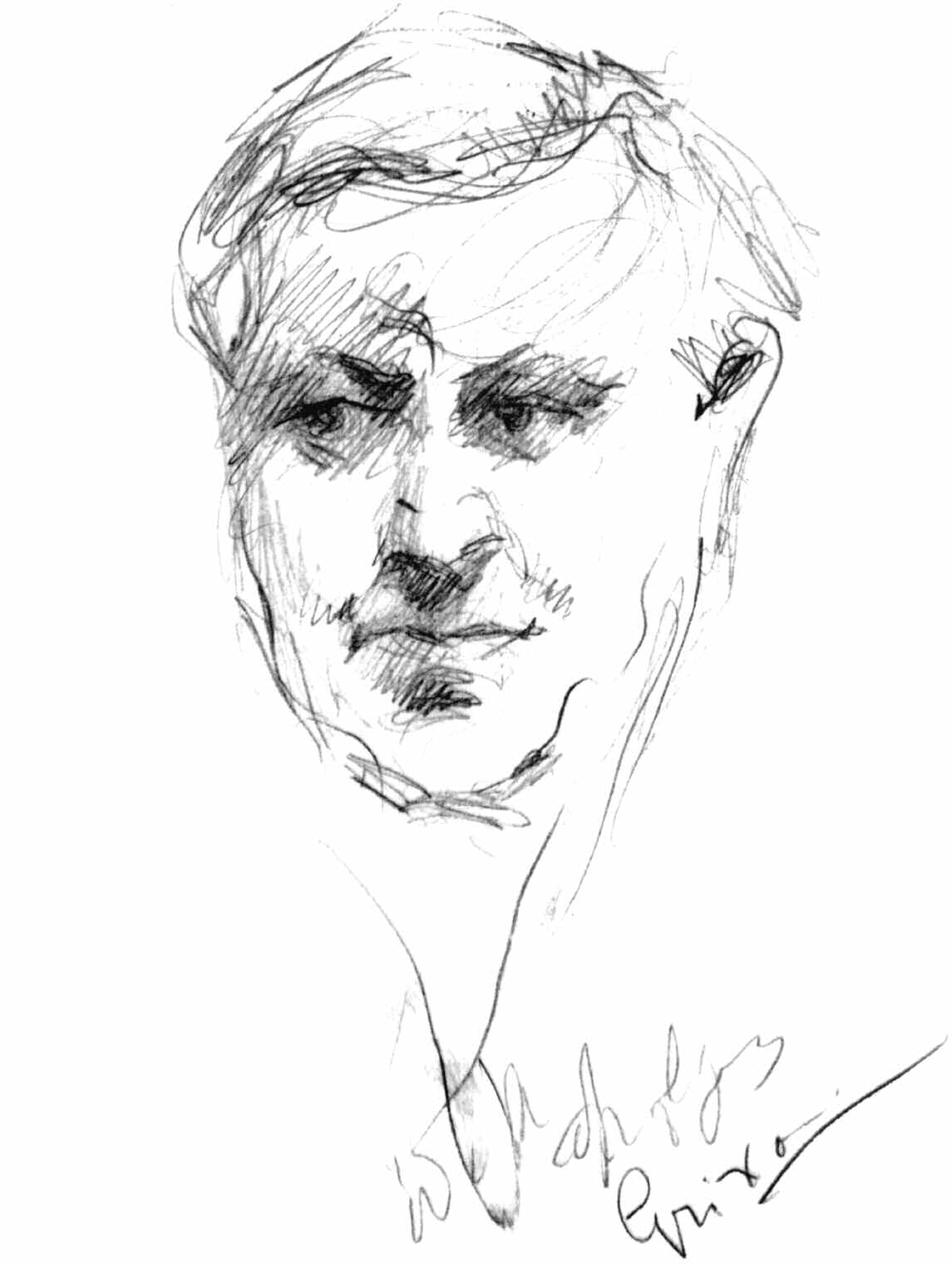
Ralph Walker
sketch from
architectsandartisans.com
Sort of a new way of thinking about myself, I suppose. While I won't comment too much about the "time distance" between then and now, I was indeed very fortunate to have met Ralph when I was a young man. For some reason, when I first came to New York, Ralph took a great interest in the young man from Virginia, and for the next six years he and I had a very special friendship. He introduced me to many people he knew, and seemed to delight in having me - and my sometimes girlfriend in those days - come to Walkerburn - his beautiful home in Chappaqua - for week-end visits. With his housekeeper and cook Louise we had many good times (and shared wonderful meals) and had long, long conversations about ever so many things. He was a widower (his wife had died a couple of years before I met him), and he and Louise seemed to take a special interest in me (or us) as their guests.

And in New York itself - on his several-times-a-week days in the city - Ralph took on the very easy task of speaking with me about art, architecture, music, the theatre, New York's history, the Murray Hill neighborhood (where I lived - and still live), and the myriad other subjects in which we both shared interest. And it was an easy task, too, for I had never met anyone quite as knowledgeable about so many subjects as Ralph was. I was a very receptive audience and although he spoke often about how much he took from me - about young people, "modern life" (he loved to say that), and similar topics that emphasized our differences, now as I remember our friendship I'm convinced that I was the real beneficiary of this interaction between two people from such different times (we were 51 years apart in age I later figured out).

We also did a lot of things together, since he was an avid opera fan and enjoyed the theatre, as I mentioned in the documentary. He was an avid museum goer, and I certainly couldn't resist when he asked me to come along to one of the city's great museums (he specially loved the Metropolitan Museum of Art, not surprisingly since the "gentleman's office" he designed for one of his buildings was once displayed there in an exhibition of contemporary office design). And I have a memory of being told that he designed the Grace Rogers Rainey Auditorium at the Metropolitan Museum, but I can't find the reference at the moment, and I'm not sure he spoke about it or if it's just something I remember).

But saying that seems to imply Ralph would have wanted to go to the Met from self-interest which, from my experience, would have been just about as far as we could get in describing Ralph's personality. He was not that way at all.

But he did have opinions, many of which are discussed in the documentary and in the writings about Ralph and his work and what he thought about other people's work.

The story of how I got involved in the documentary is perhaps of interest, at least from my point of view, because it's one more example of those serendipitous things that seem to happen as we go through life. For some reason, I heard that one of Ralph's buildings (the West 18th St. Telephone Building, now called Walker Tower) was to be re-purposed into residency apartments - makes sense, doesn't it, now that communication technologies have changed so drastically since the building was built in 1931? - and that an exhibition about Ralph's work was installed in the lobby of the ground floor of the building. So Andrew and I made an appointment (required) and went to see what we could see.

Walker Tower
We were thrilled. Even, perhaps, mesmerized (might be a better word for what we experienced) as we took in the very well-designed and well-installed items that made up the exhibition. Andrew is an amateur architecture historian specializing in American and, especially, New York architecture, so there I was - in the first exhibition ever about the work of someone I knew so well early in my life, and I had my own private expert to show me around.

We also had a very knowledgeable guide - whose name I've since lost - who give us a very informative background and introductory talk and then just turned us loose to walk around through the exhibit. We had a grand time and spent - I would guess - more time with the exhibit than any other visitors who came to see it. And as there was no one else there when we were, we just took our time.

The exhibition was called "Ralph Walker: Architect of the Century" and had been curated by Kathryn E. Holiday of the School of Architecture, University of Texas, Arlington (she also wrote the beautiful limited-edition catalog - published by Rizzoli in 2012 - which itself is turning out to be a valuable reference for studying Ralph's work).

We reluctantly finished our time with the exhibit, and as we were preparing to leave, the guide commented that although she hadn't been eavesdropping she did notice that I seemed to know a lot about Ralph and his work. I went into my "I'll-be-modest" routine but Andrew encouraged me to tell her more about knowing him when I was a young man.

So I jumped in and had a fine time talking about how I knew Ralph in the late 1960s and early 1970s, and it was from that conversation (I assume) that my name got to the producers at WNET's "Treasures of New York" series. When they decided to put together the documentary, I was contacted and spent a delightful afternoon speaking about Ralph with one of the WNET Executive Producers at my home. That led to a call from the show's producer who indicated that the program needed someone who knew Ralph personally (I think they had plenty of academic and technical and architectural experts) and we were on our way.

Great fun, and as I've thought more about Ralph and his life and knowing him, I'm hoping to continue this commentary with some of Guy's thoughts about his writings, some of his philosophy and experiences that he shared with me (he was a marvelous story teller). Stay tuned.