Tuesday, October 11, 2016

Ada and Michelle — Let's Focus on Girls’ Education


Ada Lovelace
(Photo: Science & Society
Picture Gallery)
Today — the second Tuesday in October — is observed as Ada Lovelace Day, an international celebration day of the achievement of women in science, technology, engineering, and math (STEM). The goal — according to the event's organizers and described at their Ada Lovelace Day (ADA) site 
— is to "increase the profile of women in STEM and in doing so create new role models who will encourage more girls into STEM careers and support women already working in STEM." Their day is named for and honors Augusta Ada Byron, Lady Lovelace. I begin my homage to Countess Lovelace with this 1840 portrait of her by Alfred Edward Chalon.

For 2016, there is a remarkable coincidence in celebrating Ada Lovelace Day. As a result of youth advocacy around the world, the U.N. has since 2011 declared October 11 as the International Day of the Girl Child, with its mission stated as “to help galvanize worldwide enthusiasm for goals to better girls’ lives, providing an opportunity for them to show leadership and reach their full potential.” The United States "branch" of this global movement — as described by the U.N. — encourages activist groups to come together under the same goal to highlight, discuss, and take action to advance rights and opportunities for girls everywhere. So for the United Nations, October 11 celebrates not just a day but, as the U.N. describes it, a movement. 

Mrs. Obama with her
Let Girls Learn students
(Photo: go4womens.org)
And of particular note in the United States, October 11 is the Day of the Girl, coming out of First Lady Michelle Obama's office in recognition of the work she and the President are doing with Let Girls Learn, an initiative launched in March 2015. The purpose of Let Girls Learn is to leverage public-private partnerships and challenge others to commit resources to improve the lives of adolescent girls worldwide. The program, in concert with a variety of other organizations, seeks to address the range of challenges preventing adolescent girls from attaining a quality education for empowering them to reach their full potential. And those challenges are described by Let Girls Learn: "Unfortunately today more than 62 million girls around the world are not in school — half of whom are adolescents. We know that countries with more girls in secondary school tend to have lower maternal mortality rates, lower infant mortality rates, lower rates of HIV/AIDS, and better child nutrition. But too often, a girl who could change her world for the better is locked out of that future by the circumstances of her birth or the customs of her community and country."

It's a tall order, and I'm brave enough to try to bring together — in this post — a look at how it might all be connected. And for this grandfather of six sensational young women (plus a sensational young grandson as well), I like thinking about what their lives are going to be like as they move into this world we've created with digitized information, knowledge services, and — more important than anything else — strategic learning. We're all going to be required to give more and more attention to knowledge sharing (which we all accept is the fundamental attribute of learning, whether it's learning for the workplace and our career interests or simply learning so we can strengthen and enhance our own personal capabilities). So while I don't give less consideration to what's happening with boys and young men, I particularly like thinking about Ada Lovelace in this connection. In one way, she brought together for us all that we're experiencing with knowledge sharing today.

[And certainly our First Lady is doing her part. Of course Let Girls Learn is amazingly serious — and we all admire her and the President greatly for what they are doing. But she also has very novel ways — or perhaps not so novel — for getting the message out. If you don't believe me go to her appearance on Carpool Karaoke and have some fun!]

But I digress. What I'm trying to do here is give some attention to how far we've come, and the only place I can seriously begin is with — to use her more formal title — Augusta Ada King-Noel, Countess of Lovelace (1815-1852). The only legitimate child of Lord Byron and Anne Isabella Milbanke ("Anabella"), Lady Wentworth, she never really knew her father, as he left England when she was just a few months old. He died, without her ever seeing him again, when she was eight years old.

Ada Lovelace
(Photo: English Wikipedia)
I can’t say for sure when I was first taken with Ada (seen here in a portrait by Margaret Sarah Carpenter from 1836, when Ada was 21 years old and obviously attired for some major social function!). Probably sometime back when I was studying library and information science, about the time when computers and digitization were being discussed often. I was probably told some of her story by someone I knew. And being the incurable romantic I am and with an on-going fascination since childhood for English literature and poetry (and of course Lord Byron — both his work and his life! — what young person isn’t caught up in all that?), I think Ada and her efforts to be “more” than was expected of an aristocratic young lady of her time had great appeal. And certainly as an adult I became pretty caught up in her character when Tom Stoppard’s play “Arcadia” opened in 1993; that was when this delightful young woman (apparently — according to some — based on Ada Lovelace) took her place in my heart. The character Thomasina Coverly in “Arcadia” was working on different scientific theories but her personality came through to me.

For the “real” Ada, it wasn’t particularly easy going. There were problems with her mother, whose bitterness — probably warranted — about her husband’s departure seemed to make her fear that Ada would turn out to be too sensitive (today we would probably say “high-strung”). So Ada was pushed into mathematics and technology to perhaps distract her from more ethereal and what we would call "cultural" interests; you can certainly see the connection with young women thinking about careers in STEM today, can’t you? She seems to have not been able to pull herself completely away from thinking about her father’s literary and poetical direction (she even referred to how she considered mathematics and her interests as “poetical science”), so she became an early example, a living example of an intellectual woman who could combine the arts and the sciences. Obviously in her case the sciences won out.

Ada Lovelace House
12 St. James Square, London
(Photo: Andrew Berner)
And get into the sciences she did, and that interest led her — as a young society lady meeting many people both at court and otherwise — to come to know scientists, writers, and others influential in society. And I was lucky enough — as seen here — to find her house when I was recently in London.

At the Ada Lovelace Day site we get a good summary of some of what she did in a neat little two-paragraph introduction for people meeting up with Ada for the first time:
Born in 1815, Ada Lovelace collaborated with inventor Charles Babbage on his general purpose computing machine, the Analytical Engine. In 1843, Lovelace published what we would now call a computer program to generate Bernoulli Numbers. Whilst Babbage had written fragments of programs before, Lovelace's was the most complete, most elaborate and the first published. 
More importantly, Lovelace was the first person to foresee the creative potential of the Engine. She explained how it could do so much more than merely calculate numbers, and could potentially create music and art, given the right programming and inputs. Her vision of computing's possibilities was unmatched by any of her peers and went unrecognized for a century.
And while there has been, from time to time, some controversy about her writings, with evidence offered that Babbage probably wrote more of her material than was recognized at the time, the controversy does not weaken the case for her importance to those of us who deal with knowledge services. And she was, indeed, good at music and art even though her true intellectual success came with her scientific studies. This was of course long before C.P. Snow and his writings about the two cultures (The Two Cultures and the Scientific Revolution). In 1959 — and long beyond — he had us all thinking about how combining the sciences and the humanities is required if we are not to “impede progress” in solving the world’s problems. Nevertheless Snow’s work and much that came after it (and still being discussed) demonstrates to us that with the right encouragement, the two cultures can work together to bring about important, nay critical and essential societal change.

This assertion becomes clear when we look back on Ada’s story, by now having been told in many places, including a rather well-told tale in an updated chapter (Ada Lovelace: Victorian Computer Visionary) from the 2nd edition of the STEM anthology A Passion for Science: Tales of Discovery and Invention, available at the Ada Lovelace Day site. I have two particular favorites, both fairly recent. James Gleick — a master story-teller himself — has a great time with Ada’s story in The Information — A History, a Theory, a Flood (New York: Pantheon, 2011). Even more fun is Walter Isaacson’s The Innovators — How a Group of Hackers, Geniuses, and Geeks Created the Digital Revolution (New York: Simon and Schuster, 2014). Isaacson not only opens his book with Ada, he closes it with valuable conclusions about her and her contribution. This is my take-away from Isaacson at the end of his book:

This interplay between technology and the arts will eventually result in completely new forms of expression and formats of media. “This innovation will come from people who are able to link beauty to engineering, humanity to technology, and poetry to processors,” coming from “creators who can flourish where the arts intersect with the sciences and who have a rebellious sense of wonder that opens them to the beauty of both.”


_____
Guy St. Clair is the author of Knowledge Services: A Strategic Framework for the 21st Century Organization (Munich and Boston: De Gruyter, 2016). His Amazon author page is amazon.com/author/guystclair.


Sunday, September 11, 2016

Observing 9/11


There have been references to 9/11 here. In 2013, for example, I wrote A Thought for September 11 and even earlier, in 2011, I shared anniversary thoughts in Ten Years Later, so it might be time to move on and let the past be the past. Indeed, “move on” was the phrase I used in the 2011 post: “Yet ten years later, as the anniversary of 9/11 approached, most of us had moved on. We are living in a different world now and, yes, one greatly changed by the actions of that horrible day. But we had — nevertheless — moved on.”

Have we? Now I'm not quite so sure. Conversations with several friends over the past few days, and especially with two special and long-time friends (one in England and one in Germany) make it clear that, yes, the world has changed and today’s world has little in common with the pre-9/11 world. So it is undoubtedly a “different” world we inhabit nowadays. But is it a better world? Did we learn anything from 9/11? Did we fix anything?

Canterbury Cathedral
(Photo: Andrew Berner)
Many of my friends like to characterize me (sometimes teasingly) as one variation of that sort of “eternal optimist” we hear about from time to time. Others pick up on my habit of putting out of my mind (usually without realizing it) any “bad things” that happen and literally not remembering them, even when I’m reminded that they happened.

Perhaps both characterizations fit but I’m now realizing — for perhaps the first time in fifteen years — that I’m beginning to arrive at some sort of emotional maturity about 9/11 (acceptance?), although I expect my situation at the time wasn’t particularly unique. All of us went through the horrors of the experience and in many respects I'm sure what happened to me was not unlike things that happened to others. Nevertheless, my experience affected me.

In my case, I was in a meeting at the Pentagon when the first plane hit the World Trade Center. Someone rushed into our meeting with the news and almost immediately a huge television on the wall came alive and on it we witnessed the second airplane crashing into the second tower. Not long after (I don't know how long but I think I passed out or something, because I remember someone bringing me around), I was able to leave the building to get to my rental car. While driving out of the now very crowded circular highway around the Pentagon, I saw the airplane targeted for Washington dive into the building. All the traffic sped away as fast as we could get out of there. Once back at the hotel — where watching Peter Jennings I remained mesmerized for the rest of the day — all I could think about was getting back to New York (as I was able to do on the first train back to New York the next day).

Die Neue Synagoge — Berlin
(Photo: Andrew Berner)
So 9/11 was a truly unbelievable experience but, as I say, not only for me but I suppose for millions of others as well. And what came of it, on the personal level for us as citizens of the world or as citizens of wherever we happen to live? I don’t know the answer to that question and being neither a philosopher nor particularly religious (I’m probably one of those “none” believers we hear about from the Pew Research Center) but even thinking in those directions, I am not sure that is where the answer lies. Nevertheless — and as a little aside — I continue to be impressed with what some of the recognized philosophers have to say. And I continue to respect people who have faith. I enjoy sacred music (particularly choral sacred works) and visiting monuments of faith, as we might call them. When I travel, I take special pleasure in seeing these magnificent buildings and having them captured in photos (some shown here). And there's no question but that I open my heart to the many generations of ages past whose faith led them to expect some version of “deliverance” as society moved forward and how they demonstrated their faith in constructing these splendid religious monuments.

La Mezquita — The Great Mosque of Córdoba
(Photo: Andrew Berner)
And not just people of the past, for there are believers today, whether believers in some religious faith or simply humanists and enlightened thinkers who believe in the “goodness of man” (as it is sometimes expressed). But are we advancing? Of course the world has changed since 9/11, and in ways that demonstrate clearly that the pre-9/11 world will never return. Yet knowing full well that our world will never be the same again, how do we get beyond what we are witnessing and truly frightened about? Most of the people I know (myself included) are considerably distressed with the nasty political battle going on in the United States, and the possibility of destroying the society we have and building a new society based on lies and hatred (of immigrants and any "others" who seem to be so casually identified). Despite our faith in humanity — no matter how limited — such a society is destined to self-destruct and, I fear, to do so sooner rather than later. We are very frightened and while we try to be optimistic, it is difficult. We feel it all around us. Everyone is frightened.

Marble Collegiate Church
(Photo: Marble Collegiate Church)
So what conclusions are left for us? Where do we go from here? Believing strongly in that optimism I’m characterized with I want our society — local, regional, nationally, and yes, even internationally — to advance, and while there are no simple answers to the question, I think we must look to two points of view that in my opinion would give us strength. And perhaps might help us deal with what we're up against.

One, not surprisingly, is simply trust. No long definitions of trust or the value of trust are required at this point. We know what we are talking about and all we have to do is have the strength (and especially ask our leaders to have the strength) to think in terms of trust and not in terms of “gotcha.”

And there’s more: What would happen if we returned to the almost simplistic leadership (speaking of leaders) of one of the most talked-about people of the past? Wasn’t it the Rev. Norman Vincent Peale — at Marble Collegiate Church just a few blocks from where I now live — who urged a mantra of “positive thinking”? Of course the idea as formalized and preached by Dr. Peale was and remains controversial. And certainly “positive thinking” as described by Dr. Peale is not advocated by many serious thinkers today. But what would our world be like if, in fact, our leaders (not just, but especially world leaders) replaced fright and hatred with a positive approach to getting along? I know nothing about diplomacy but I can’t help but wonder if such an approach it possible. Probably not, but the words — even if only as words just because they are out there and part of our vernacular — could be given some thought. Could this be a direction for our post 9/11 society?

Monday, August 29, 2016

Still in the News: Elephant Poaching Continues


Friends and colleagues know that among Mr. Guy's favorite things in life (aside from his family, it goes without saying), elephants rank high up there, probably the result of his thrilling experiences living in Kenya and spending as much time as he could going off with his driver Charles to look for elephants. [More about that in the posts noted to the left, dating from late 2009 to early 2011, with one dating from January, 2014.]

No need to go into a lot of description here except to note that in Africa, according to the World Wildlife Fund, the splendid African elephant comes in two sub-species, the Savannah (or bush) elephant and the Forest elephant. I love them all, and I've decided that — for a gentle re-entry back into the world of "Sharing Guy's Journey" — I'll share a few elephant-related thoughts for those who join with me in thinking about this magnificent animal (which the WWF refers to as "the largest animal walking the Earth).

And a little later I'll get to telling some sweet stories to top up part of what I've told earlier (and encouraging anyone reading this to look back at my favorite elephant story about the old-lady elephant who came to mean so much to me).

But first I want to tackle a problem that seems to keep coming back. Despite a certain tendency toward some level of optimism over the last couple of decades or so, the news about elephant poaching continues to be bad. I'm not sure what's going on, but there is surely some lack of motivation, probably having to do with the times we're living in. We have the international situation with Syria and terrorism news from all over the world. Then there's the attention given to attempting to deal with some version of post-Brexit governance and in the United States we have distractions of what purports to be a political campaign.


So is it any wonder that this particular subject — which worries so many of us — is "out-of-bounds" for most media? Certainly we were all pleased to read about President Uhuru Kenyatta of Kenya repeating a poached-ivory burning ceremony originally performed in 1989, with an impressive monument later built to commemorate Kenya's President (at the time) Daniel arap Moi's burning of some 12 tons of elephant tusks. The monument (shown here) is a popular tourist site within Nairobi National Park, attracting visitors at all times of the year. And the poached-ivory burning ceremony was an action that seemed to have given new attention to changing global policy on exporting ivory. So this past April 30 President Kenyatta oversaw a similar ceremony, which National Geographic described as the destruction of 105 tons of elephant ivory and 1.35 tons of rhino horn, "the final remains," the National Geographic news service reported, "of some 6,500 elephants and 450 rhinos killed for their tusks and horns."

That's a very noble response to what is an amazing — in the literal sense of the word — endangered species destruction. But it is also troubling to think that an additional 105 tons of illegal ivory was confiscated between 1989 and 2016. To my way of thinking, it is almost inconceivable that as our society becomes more and more civilized (as we hope is happening) such damage occurs. I recently heard from a good friend who follows these things with more scholarly (and personal) background than I, that Avaaz — an apparently well-known global civic campaigning community — reports that "Every 15 minutes an elephant is brutally slaughtered for its tusks, and at this rate they will be gone forever in just a few years." The report from Avaaz goes on to state that "momentum is growing for a complete global ban on ivory" but notes sadly that the European Commission in a position paper released last month (according to The Guardian) has indicated that "rather than an all-encompassing ban it would be better to encourage countries with growing elephant numbers to 'sustainably manage' their populations."

Doesn't this seem like an odd response to a problem that is clearly recognized throughout many countries? Over the past couple of years, The New York Times has been running a very informative series of articles about elephant poaching and the dangers of extinction for this remarkable species (just search "elephant poaching" in The New York Times). I think all civilized peoples recognize that the elephant-poaching crisis is heartbreaking. Some 29 African governments have predicted mass extinction within 25 years unless a full-scale ban on any future domestic ivory trade is enacted. What possible reasons could there be — other than greed — to oppose a ban on the sale of ivory?

These are questions I'm not qualified to answer but that does not mean I don't think about them. And as I spend a little more time thinking about elephants in future blog posts (happier stories I promise) this sad situation has to be kept in mind. It was aviatrix Beryl Markham, in West with the Night, who provides us with a closing thought for today for this subject:
"It is absurd for a man to kill an elephant. It is not brutal, it is not heroic, and certainly it is not easy; it is just one of those preposterous things that men do...."

Tuesday, May 10, 2016

A Truly Exciting New Novel (Young Adult Division)


Welcome back.

Alwyn Hamilton
Except for the posts about Impressionism on January 1 and the Mahler 8 on February 26, I've been neglecting my personal blog. All for good reason: although not teaching this past semester, I chose to spend my time finishing up my next book. More information about that project when Knowledge Services: A Strategic Framework for the 21st Century Organization is published in mid-September.

Speaking of books, though, I want to alert all my friends to one of the most exciting books I've read in a long time. As it turns out, the book is one of a genre referred to as "young adult fiction" but I don't mention that designation to turn my adult friends and colleagues away. In fact, young adult fiction (thought of as fiction written for 15-to-18-year-olds, but depending on the definition you read, the term also refers to readers between the ages of 15 to early twenties) can be greatly pleasurable for anyone who likes to read. The timeframe for the target market doesn't matter. Some adults still enjoy reading young adult fiction (I'm one of them—one of my favorite books continues to be Philip Pullman's His Dark Materials, still a terrific read twenty years after the first volume was published).

And now I have a new favorite: Alwyn Hamilton's Rebel of the Sands. Just out in March, Hamilton's exciting book is set in a fictional time and place. The former is somewhere in the future (I think—but perhaps not) and the place is an exotic and mixed-landscape piece of the earth somewhere in Africa (or perhaps somewhere else—in any case it's a place where there's lots of sand). That little description gives you an idea of the enormous amount of energy, research, and creative thinking that has gone into the book, and even such notables as Jeff Giles, writing in The New York Times Book Review (April 10, 2016) recognize the quality of what Hamilton has done:

"'Rebel of the Sands' (Giles writes) is a winning bit of storytelling, as well as a homage to storytelling itself. It evokes such disparate influences—'1,001 Arabian Nights,' Hindu lore, and Navajo myth, as well as, inevitably, the triumvirate of Tolkien, Lucas, and Rowling—that at times you wonder whether Hamilton can pull it all off. She can. She has circled a spot on the map and claimed it for her own." And I want to be among Giles and the many others showering Hamilton with congratulations (and with full disclosure: I have known Hamilton and her brother since they were youngsters—their parents are good friends of mine).

My title for this blog post is intentional. Indeed, "exciting" might be a trifle too tame for what Hamilton has created. It's truly a classic page-turner and I hate to think of how many chores didn't get done at my house because Mr. Guy just wanted to keep reading. This book is just too much fun not to (keep reading, that is, not doing chores). It's the first volume in a trilogy, just like Pullman's Northern Lights (published as The Golden Compass in America), and I'm already looking forward to Hamilton's next volume.

The overall plot is good, and the story basically comes down to how smart and quick the heroine is. She's Amani Al'Hiza, and whether she is camouflaged as a boy (which seems to be most of the time) or being her real self, her skill with a gun is amazing to read about. In this land of immortal horses and mystical colleagues and magical djinn, Amani Al'Hiza finds herself in situations that I found simply thrilling to read about. Of course there's romance. Why wouldn't there be? And when our sharpshooter heroine and the guy she finds herself taking up with start to get together, the news is (most of the time) good. There are a few little guy/girl skirmishes but they get resolved in pretty short order, especially when the two of them (our leading man is Jin who is—not to put too fine a point on it—also a true hero) find themselves caught up between two groups of warring princes.

Get the drift? This one is really fun, and if you have young adult children and grandchildren (or if you're like me and like to read this kind of literature just for the fun of it), this is a book I recommend. Will it replace Pullman for me? Ask me in a year. Right about now, I'm leaning toward Hamilton's new book.


Friday, February 26, 2016

Mahler's Symphony No. 8 — What a Treat!


Gustav Mahler 1860-1911
I've been a Mahler fan for most of my life. Don't know when it started but I'm well aware of the effect a Mahler symphony (and many of the songs) have on me. While the Second has been the one most often to bring me to tears (and to my feet when the applause starts, if I'm hearing a live presentation), it was the Eighth I could never get to hear in a live performance.

I love the Second, and I never tire of hearing it, either live or recorded, and I've attended many performances, both here in New York and in many cities I've traveled to. And I've never been disappointed; the music of the Second does not—in my opinion—lend itself to disappointment.

And the Second has a singular very special memory, too, for the most disrupting—in a positive sense of the word—performance of the Second I ever heard took place back on September 11, 2011. The New York Philharmonic, as its gift of remembrance to the citizens of New York on the 10th anniversary of the attacks, packed Philharmonic Hall with a free concert. And for those who could not get tickets, they set up chairs for thousands of people so they could be outside on Lincoln Center Plaza and watch the performance on huge projection screens and hear the music through a massive speaker system.

I was lucky enough to get in, along with a visiting and great personal friend from Berlin (who to this day remembers to thank me for taking her to that concert). The only down-side was that the free tickets were handed out helter-skelter, in no order, and we didn't get to sit together. No matter! It was an evening to remember, for many reasons, and I've thought often back on what that evening meant to so many of us New Yorkers. The performance got a lot of attention, and critic Graham Parker described what we were all feeling better than I ever could:

"At the end of the performance," Parker wrote, "what stood out for me was not the immediate ovation from the crowd in the hall, but the looks on the faces on the musicians of the Philharmonic. These jaded New Yorkers suddenly realized what they had done. They had helped heal through notes and gesture. They had given the hundreds of victims’ families and first responders a new perspective on the tragedy through their artistry. They had, in the most dramatic of terms, played like the great orchestra that they are. You could see that they had been changed by Mahler's 90 minutes of drama."

So I always approach Mahler with a certain point of view. I don't know quite how to describe it (reverence? awe? just sheer happiness to be able to experience this composer's great output? who knows?). The one thing that had been missing, though, was the Eighth. I knew about it. I have had for a time a splendid old CD of Rafael Kubelik and the Symphonie-Orchester des Bayerischen Rundfunds (a re-mastered performance of about 1970 or so). And I've loved listening to it. But I had never attended a performance. It isn't performed that often (the logistics must be very forbidding except for the most well-organized and well-funded musical organizations) and, well, when it had been performed I had not been able to attend. I must have been traveling or something. 

And even though I had the recording, and occasionally listened on the radio when I knew in advance the Eighth was going to be performed, it wasn't the same. There's no way to get around it: any piece nicknamed "Symphonie der Tausend" is going to lose a little something in a recording. The piece wasn't called that for a joke. As James M. Keller wrote in a program notes for the New York Philharmonic several years ago—for a performance that I missed because that was a performance when was traveling and I remember clearly how disappointed I was to miss it—"The symphony's personnel requirements are indeed extraordinary. Its premiere included the participation of 858 singers and 171 instrumentalists (plus one conductor—Mahler himself)." Just reading the description of that first performance—on September 12, 1910—makes it clear that this is a symphony to be experienced in person, not in a recording.

On the other hand, YouTube has a very good video of the Eighth, something I had discovered some time back, a two-part video of the complete program. It's Dudamel conducting the Los Angeles Philharmonic in Caracas. It was the conclusion of the mighty LA Philharmonic and the Simón Bolívar Symphony Orchestra's Mahler Project in 2012, performing all of Mahler's symphonies first in Los Angeles and then in Caracas (if you want to try it, Part 1 is here and Part 2 is here). This is definitely worth listening to, if a live performance isn't available.

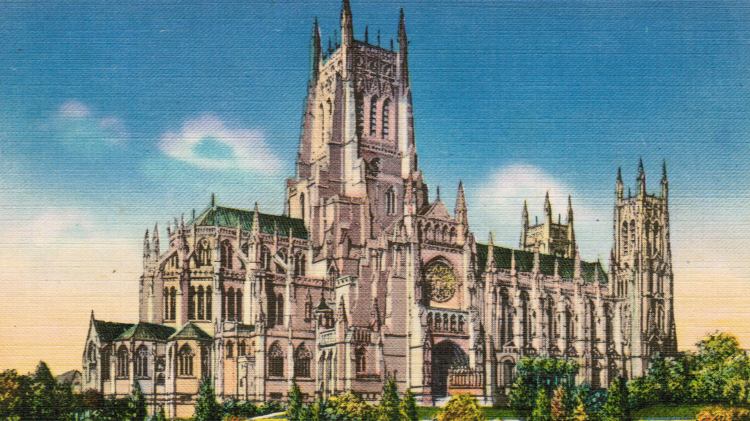
The Cathedral Church of Saint John the Divine in New York
So why all this lead-in? Because now I've heard it—live! And it was one of those once-in-a-lifetime experiences that gives true meaning to the old idea of being in the right place at the right time. I'm so happy I live where I live. In the January issue of Opera News there was a delightfully fulsome article about Kent Tritle, one of the most popular (and famous) musicians in New York. His "real" job—I suppose it would be called—is Director of Cathedral Music at The Cathedral Church of Saint John the Divine on Manhattan's Upper West Side but that's only the beginning. He is also the conductor of Musica Sacra, the Oratorio Society of New York, and all the choirs of the cathedral. He teaches at Manhattan School of Music and the Julliard School, he is the organist for the cathedral, and as well as organist for the New York Philharmonic and the American Symphony Orchestra. And he was (briefly, sadly) host of a weekly Sunday radio show on New York's WQXR, our classical station, on choral music. He widely recognized for his good work, and when the Opera News article described the up-coming Mahler Eighth, we all ran for tickets. 

The performance was in the great nave of the cathedral, which gives an idea of what the sound was like (complete with about a 5-second reverberation according to one of our group, which just emphasized how engrossing—I suppose that's the right word—)the sound was. We were seated a little less than half-way back, and the sound was excellent. We could hear everything being sung very clearly; and the Eighth—as Mahler himself described it—is a "vocal symphony (just like my beloved Second, the Third, and the Fourth) so it is clearly critical to the performance that the singing come through as clearly and as cleanly as possible. It worked in this performance—there was no "muddling" (at least as far as I could tell—and that sometimes happens with these big choral pieces). And while there was a big crowd (someone told me the nave seated 5,000 people for each of the two performances—I'll take their word for it—I wasn't about to count!), in that high-ceilinged stone space, certainly all those human bodies didn't contribute to muddling the sound either. It was all just as clear as it should be.

And it was big. While it wasn't the 1,000-plus performers of the premiere in 1910 (or the 1,200-plus performers in Caracas), the 360 or more performers in the Cathedral Church of St. John made quite an impression. And one of the most impressive moments? Why not? As we were taking our seats, we noticed staff setting up a music stand in the aisle right next to where we were to sit. OK. I've performed Dvořák's Stabat Mater at St. Bartholomew's Church back in the old days of the great choir, and, yes, we had brass all over the upper balconies and in the back so I sort of knew what to expect. And sure enough, as we got toward the conclusion of Part 1, an associate conductor carrying his score came out to use that music stand and I looked up. On either side of us—high above the church floor—each of the tall arched openings had a brass player with instrument in place. At the precise moment, following the associate conductor next to us and Tritle up front, we had what must have been one of the most spectacular sounds I've ever heard. And of course it all gets repeated at the finale of Part 2. What a show! 

So there really is no way to convey any of what we heard, other than to just say how grateful I feel we are to be living in a time when we have experiences like this available to us. We are so lucky—as we in our family talk about all the time—and it's moments like this that when we share them (or when we write about them and read about them), we're aware that there is something very good going on. What splendid music we have to listen to!

Friday, January 1, 2016

Impressionist Pictures that Impress


A recent visit from a young relative got me to thinking about some of the art works that I keep returning to and enjoying. Our cousin had come to us on a brief visit once before, but now she was with us to explore New York City with her grandmother and to see parts of the city which would be of particular interest to her.
Her list included the Metropolitan Museum of Art, important to her now because—even though she comes from a family that takes art seriously and enjoys many family visits to neighboring museums and galleries where they live (Tennessee)—this was to be her first visit to the Met since she had moved on with her education. She's now in her first year at university, and art history and art appreciation are now being taken very seriously.  

When she returned from the museum, her enthusiasm for the Impressionists was very evident, and she asked me to describe for her the Impressionist pictures that appeal most me. I told her, and I'll share these with you, too. It seems like a nice way to usher in the new year, to share something beautiful that has special meaning, and our cousin seemed to like hearing about the three paintings described here.

I had fun with our little conversation, trying to tell her why each of these pictures is special to me, playing with each one and coming up with my own explanations. She seemed to like the stories I told. The fact that two are by Pierre-Auguste Renoir (1841-1919) and one by his close contemporary Gustave Caillebotte (1848-1894) probably tells our visitor more about Mr. Guy than about Impressionism, but I was able—I think—to give her a good idea of the period in French history and French art that most interests me.

As we spoke about the paintings, I talked about how these represent what is called "genre painting," that is pictures that tell a story of everyday life, with the artist giving us viewers a snapshot—we might call it—of a particular event or activity. And in most cases the activity in genre painting was not particularly noble or had anything to do with the aristocracy or gods and goddesses. Just a look into something happening at a particular place and at a particular time.

Pierre-Auguste Renoir
Bal du moulin de la Galette
Musée d'Orsay, Paris
Certainly that's what attracted me to Renoir's 1876 Bal du moulin de la Galette. The idea of being with these normal, working-class folks dressed up for a light meal and dancing on a Sunday afternoon appealed very much to me. And the people in the picture weren't all necessarily working-class people, for somewhere along the way I learned that some of them were professional or semi-professional friends of Renoir, like Georges Rivière, the young man with his straw hat pushed back on his head in the lower right of the painting. I had for some reason thought that Rivière was a journalist, probably because I had read—confirmed in Anne Distel's Renoir: A Sensuous Vision (London: Thames and Hudson, 1995)—that Rivière had published a magazine. Indeed, he had, briefly. At Renoir's suggestion, he had put out a periodical called L'Impressionniste, four issues of which came out in April 1877—and for one of which Renoir himself had written an essay entitled "Decorative and Contemporary Art." Rivière was, in fact, a civil servant but obviously one who gave serious attention to his writing, as he ended up being Renoir's biographer, with Renoir et ses amis published in 1921. In the book he told the story of the painting of the picture; it seems to have been a very lively afternoon when Renoir and his friends got together and he spent time with them capturing their Sunday-afternoon leisure.

One fact about this painting I like is that it was in Gustave Caillebotte's collection from 1879 to 1894, when it was transferred to the French Republic after Caillebotte's death, as Caillebotte had—at the age of twenty-eight—written in his will that his collection of paintings should be left to the State. Bal du moulin de la Galette had came into Caillebotte's collection shortly after the third Impressionist exhibition in 1877, in which twenty other Renior paintings had also been exhibited. The two men were clearly great friends, and in Distel's book she tells the sweet story that when Caillebotte decided to paint a self-portrait sometime about 1879, he used a mirror that also reflected a painting hung on the wall of his studio "which he accordingly painted in reverse." It was his friend Renoir's Bal du moulin de la Galette.

And a story I like to tell about this painting is more about me than it is about the painting. Once, years ago, we were in Paris with friends from Canterbury, people we had known for many years (as will quickly become evident). As we made our way up to the top floor of the Musée d'Orsay to see the Impressionists, I challenged my friends to spot my favorite painting (yes, I used the word). We walked into the hall and my friend Sandra took a very quick look around at all the pictures hanging all over the place and immediately—without a word—pointed to Bal du moulin de la Galette. I suppose there is nothing subtle about me, is there?

Pierre-Auguste Renoir
Le déjeuner des canotiers
Phillips Collection, Washington DC
Another special story-telling Renoir picture is the 1881 Le déjeuner des canotiers (Luncheon of the Boating Party), here in the States at the Phillips Collection in Washington, DC. It was painted on the upstairs terrace of the Fournaise restaurant, located on the island of Chiard at Chatou, a popular gathering place for boaters.

One of Renoir's best-loved paintings, for me it is always a treat to visit the Phillips and observe how the people viewing the painting just put themselves into the story. And why not? It's a luncheon you want to join. For a long time though, despite the fact that everyone depicted in the picture was a friend of Renoir, only two of the people according to Distel could be identified. In her book, she notes that the man leaning against the railing is an oarsman who was a son of Alphonse Fournaise, who owned the restaurant and the young lady playing with the dog (in front of Fournaise) is Aline Charigot, a dressmaker who would become Renoir's wife.

As it turns out, a few years after Distel's book Scala Publishers in London created (and it is offered at the Phillips as a "souvenir" book in the gift shop) a book "created after the concept of the series Découvertes Gallimard Hors Série (France). In this fold-out book, practically all the friends are named including Alphonsine Fournaise (Alphonse's sister), Gustave Caillebotte (the seated young man with the hat), Jules Laforgue, Charles Ephrussi, publisher and later owner of Gazette des beaux-arts and an important champion and collector of the Impressionists. While not a particularly scholarly approach to learning about the painting, the little book helps to introduce a very pleasant personal adventure into Impressionism. And when accompanied by Susan Vreeland's full-fledged fictional account of the afternoon party—called, like the painting, Luncheon of the Boating Party (New York: Viking, 2007)—anyone with even the lightest interest in reading about these people and what was going on will have a good time.

Gustave Caillebotte
Paris Street, Rainy Day
Art Institute of Chicago, Chicago IL
And then there's Caillebotte's own masterpiece (that "masterpiece" designation is my opinion—Caillebotte painted many very special pictures, including the one for which he is probably most famous, The Floor Scrapers, painted in 1875). He had a hard time getting started with being recognized, and he was rejected by the jurors of the 1875 Salon, for which he had submitted The Floor Scrapers. Recognition did come, though, and I find I'm particularly taken with thinking about the time and place he worked. This was the Paris that had come into being with Baron Hausmann's renovation, just winding down in the early 1870s by which time the shape of the city had been seriously changed by all the many re-buildings and the many rearrangements of the streets into what we now think of as so elegant and grand. Caillebotte excelled particularly in depicting the new look of the city, and Paris Street, Rainy Day (1877) is typical of his fine eye.

I specially love Paris Street, Rainy Day, and it, too, is on view here in the States. And just as a trip to Washington is worth it to see Luncheon of the Boating Party at the Phillips Collection, so is a trip to Chicago to go to the Art Institute and just stand in front of and be awed by this painting. The specialists at the Art Institute write about the painting's "unusual monumentality and compositional control" and it's fun to be viewing what one of the city's new boulevards might have looked like when it rained. Like many of Renoir's works, this painting, too, was shown in the third Impressionist exhibition; by that time Caillebotte was being considered one of the most active members of the Impressionist group.

I've loved it ever since I was in graduate school in Illinois, when I visited it every time I had a chance to go to Chicago. It came to New York a few years ago as part of a splendid exhibition at the Met, then went back to Chicago for a full restoration before coming to Washington for the big "Gustave Caillebotte: The Painter's Eye" exhibition at the National Gallery last summer. And what a job the restorers did with this jewel-like painting! When I visited the Art Institute to see the painting about eighteen months ago, I was amazed. It seemed that every little detail was brought to life anew (and even the small white dot in the lady's ear—which I thought was a pearl—turns out to be a diamond and a very pretty one at that).

So that's my story for a happy new year, and I thank you for allowing me the opportunity to say a little something about how nice it is to have a visit from a young relative so interested in art. And to have her listen to me as I share some of my stories about some of the special pictures I've come to know and love. Perhaps some of my enthusiasm about these pictures will rub off on her. Or perhaps on some other young person.

Happy New Year.